The 1601 Inheritance of Jozefowo: Uncovering the Earliest known Roots of the Rodziewicz Family History
Modern Polish spelling: Józefowo
This is a very significant piece of our direct Rodziewicz family history. Ferdynand Pulwin Rodziewicz is the first known ancestor of my particular branch of the family (the Vitebsk line – linia witebska).
My recent research referencing the archives of the Grand Duchy of Lithuania* has uncovered a particularly interesting early 17th-century document relating to Ferdynand’s immediate heirs. It’s a copied entry from the Vitebsk land registers (księgi ziemskie) of 1601 that records a land arrangement among Ferdynand’s three sons (Eliasz, Bronislaw, and Stanislaw Rodziewicz) regarding the Jozefowo estate after their father’s death.
*Historical and Legal Materials Extracted from Act Books of Vitebsk and Mogilev Governorates (ИСТОРИКО-ЮРИДИЧЕСКІЕ МАТЕРІАЛЫ ИЗВЛЕЧЕННЫЕ ИЗЪАКТОВЫХЪ КНИГЪ ГУБЕРНІЙ ВИТЕБСКОЙ И МОГИЛЕВСКОЙ). By Belarusian historian, archeographer, and archivist Dmitry Ivanovich Dovgyallo. Vitebsk. 1903. Pages 495–496. Digital copy at Google Play Books. Purchase required.
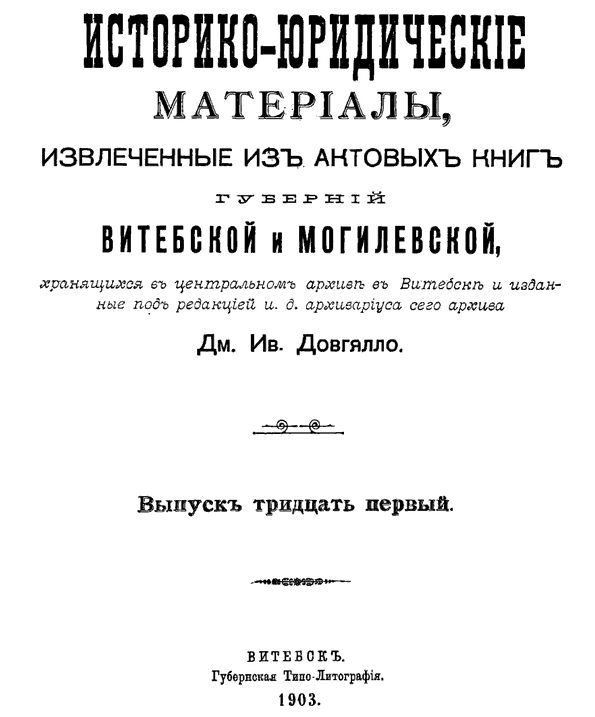
The document is an important primary source on early modern legal practice, the landed nobility (the szlachta), and land division in the eastern borderlands (the Kresy) of the Polish-Lithuanian Commonwealth.
Contextual Background: Ferdynand Rodziewicz and the Vitebsk Line
According to the Herbarz szlachty witebskiej (Armorial of the Vitebsk Nobility, Kraków 1898), Ferdynand Pulwin Rodziewicz belonged to the Vitebsk Voivodeship’s military banner (chorągiew). He owned property in powiat oszmiański (Ashmyany county), and was known to have fought against Cossack commander Dmitry Dołhonos.
For his services Nicefor Birula* granted Ferdynand a patent for sotnikostwo (a commission as a military captain in command of a company) in 1525. Sources often refer to him as Ferdynand z Pulwinów (Ferdynand of Pulwiny), which denotes the family’s place of origin or branch.
*According to the Armorial of the Vitebsk Nobility (1898), Ferdynand Pulwin Rodziewicz of the Oszmiana district served in the Vitebsk voivodeship banner during the Cossack incursions. He distinguished himself in battles against the Cossack commander Dmitry Dolgonos, for which he was awarded a military commission as a sotnik (centurion) of the Vitebsk banner by the regional military commander, Nicefor Birula.
Source: Oficjalna strona Stowarzyszenia Rodu Rodziewiczów (Official website of the Rodziewicz Family Association).
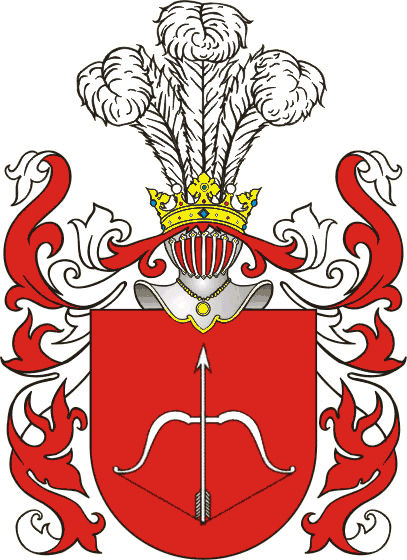
Rodziewicz Family History: Łuk Coat of Arms (Vitebsk Genealogical line)
The family bore the Łuk coat of arms (a drawn bow with an arrow pointing upwards on a red field, crested with three ostrich feathers), a recognised coat of arms in the noble heraldic assemblies of Vilnius, Minsk, Grodno, and Saint Petersburg.
Source: Herby Rodowe | Prywatna strona Włodzimierza Rodziewicza (Family Coats of Arms | Private website of Włodzimierz Rodziewicz).
Image: Łuk coat of arms: WikiMedia. GNU Free Documentation License.
The Settlement at Jozefowo
The first known document of the Rodziewicz family history
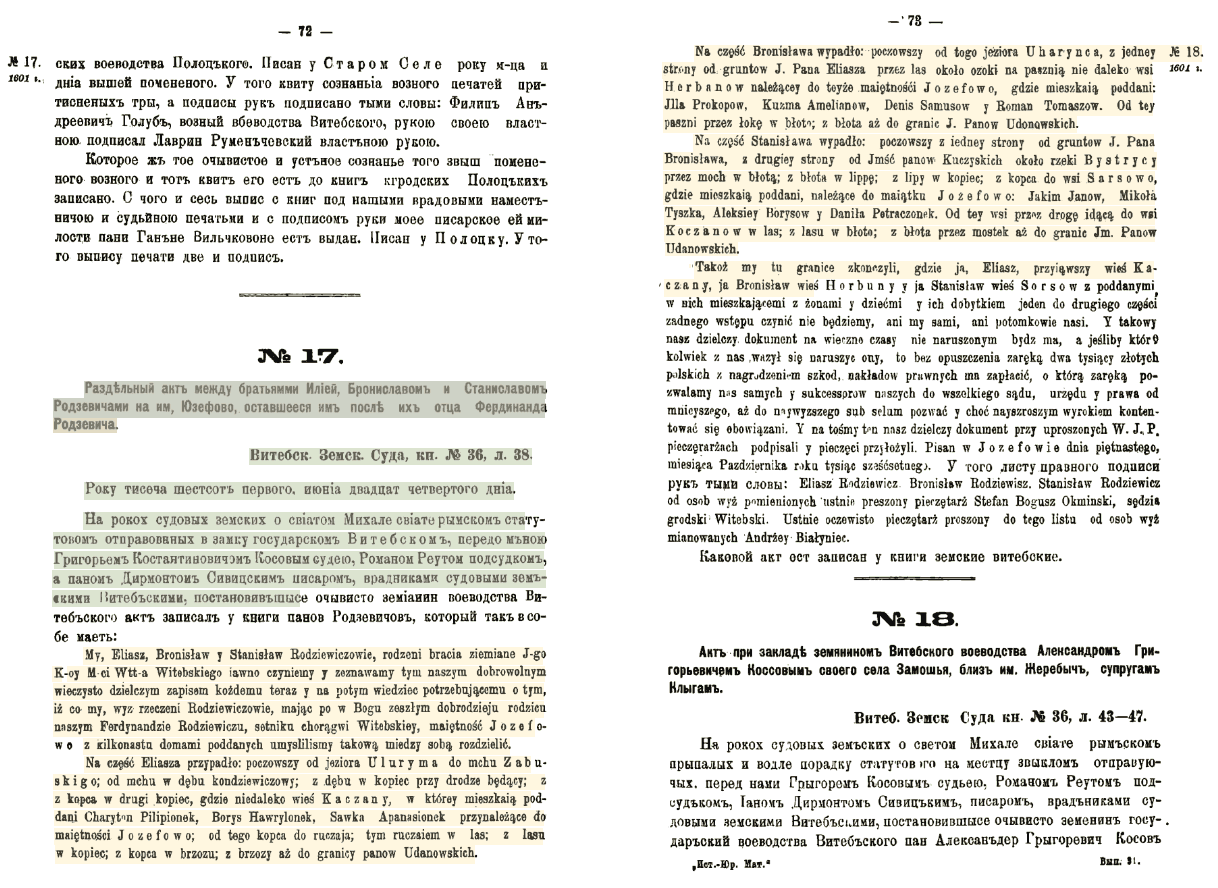
One of the most remarkable documents relating to the Rodziewicz family history survives in the records of the Vitebsk Land Court and is dated 24 June 1601. Written in the Ruthenian chancery language then used in the Grand Duchy of Lithuania, the document records the formal division of the family estate of Jozefowo among the three sons of Ferdynand Rodziewicz, following their father’s death.
The court record identifies the brothers as:
- Eliasz Rodziewicz
- Bronisław Rodziewicz
- Stanisław Rodziewicz
and states explicitly that they were the sons and heirs of Ferdynand Rodziewicz, formerly Chorąży (Standard-Bearer) of Vitebsk, an important office within the voivodeship.
The brothers appeared before the court to confirm that they had reached an amicable settlement regarding their inheritance. The estate of Jozefowo was divided into three portions, each defined in meticulous detail by lakes, streams, forests, boundary mounds, roads, and neighbouring properties. Attached to each share were peasant households whose names were also recorded in the document, providing a rare glimpse into the local community at the turn of the seventeenth century.
What makes the record especially valuable is its clarity. Rather than merely mentioning family members in passing, it formally declares the relationship between the deceased father and his sons. In genealogical terms, it functions much like a probate settlement, linking two generations of the Rodziewicz family through a contemporary legal act.
The brothers further pledged that neither they nor their descendants would challenge the division in the future. To discourage disputes, the agreement imposed a substantial financial penalty of 2,000 Polish złotys on any heir who attempted to overturn the settlement. The deed was then entered into the official books of the Vitebsk Land Court, giving it full legal force.
More than four centuries later, this single document remains one of the strongest surviving pieces of evidence connecting the Rodziewicz family of Vitebsk to their ancestral estate at Jozefowo. It preserves not only names and relationships, but also a snapshot of the landscape, society, and legal culture in which the family lived in the closing years of the Polish-Lithuanian Renaissance.
Genealogical significance: The Jozefowo settlement of 1601 provides contemporary documentary proof that Eliasz, Bronisław, and Stanisław Rodziewicz were the sons and heirs of Ferdynand Rodziewicz, former Chorąży of Vitebsk.
Note: The 1601 settlement reminds us that estates in the Grand Duchy of Lithuania were both economic units and family possessions. Along with forests, meadows and fishing rights, the Rodziewicz brothers inherited the obligations and services of peasant households attached to the estate. Remarkably, the court record preserves the names of several of those villagers, allowing individuals of otherwise humble status to emerge briefly from the historical record more than four hundred years later.
As a researcher, I find those names as valuable as the Rodziewicz brothers’ names. Noble families often appear repeatedly in records, but peasants such as Denis Samusow, Roman Tomaszow, or Danilo Petraczonek usually surface only when a legal transaction like this happened to record them. That makes the document a rare glimpse of both sides of rural Vitebsk’s social structure in 1601.
Summary Table of Peasants Named in the Settlement
| Brother | Peasants Named in the Settlement |
|---|---|
| Eliasz Rodziewicz | No individual peasants specifically named in the surviving text section |
| Bronisław Rodziewicz | Prokop; Kuzma Amelianowicz; Denis Samusow; Roman Tomaszow |
| Stanisław Rodziewicz | Jakim Janow; Mikoła (Mikita) Tyszka; Aleksiej Borysow; Danilo Petraczonek |
For the Rodziewicz family of 1601, Vitebsk was not a remote provincial town but the administrative centre where legal documents were registered, inheritances settled, and noble status confirmed. Although the city is now located in modern Belarus, the court record reflects the legal and cultural world of the Grand Duchy of Lithuania, one of the constituent states of the Polish-Lithuanian Commonwealth.
Because my ancestors appeared before the Vitebsk Land Court and Ferdynand held the office of Chorąży Witebski, the family were participating in the political and legal institutions of the Grand Duchy of Lithuania itself, not merely living in the region. That gives the document significance beyond genealogy, as it places the Rodziewiczes directly within the noble society of the Commonwealth’s eastern territories.
A note on the timeline: I record Ferdynand getting his military patent in 1525 and his sons dividing the estate in 1601. The 76-year gap between a military commission and an estate division is very much a classic genealogical anachronism. It’s almost certainly the result of a 19th-century typographical error (1575 printed as 1525) or the inclusion of an unrecorded generation with the same name in family trees.
Research & Translation Note: While I am fluent in Polish, deciphering 17th-century Ruthenian legalese recorded in Cyrillic required specialised translation. I collaborated with AI alongside family translation notes by my cousin Kazimierz Ślęczka to transcribe, verify, and render the 1601 court register into plain English.
Enjoy reading my commentary? Add South Coast View as a Preferred Source on Google to see new posts first.

Subscribe to future posts on South Coast View by email. No spam, just a notification when a new article is published.
Having trouble confirming? Read my subscription guide.
 Follow on Substack
See my explainer titled “What is Substack“.
Posts tagged with Poland. See all in Poland.
Working at The German Post Office in Kraków During WWII
August Browne: The True Story
Operation Azalea: The Night Poland Lost Its Telex and Phone Connections