Follow on Substack

The Extraordinary Odyssey of August Browne
A Life of Survival, Music, and Self-Invention
Related post: Original post about August Brown on this website.
For more than ten years, August Browne’s story was seen as a tale of wartime heroism. Known as “Ali,” he was believed to be the only Black insurgent in the 1944 Warsaw Uprising. His story became a special symbol of national pride.
But history often changes. New archival discoveries have cast serious doubt on his role in the Uprising, showing contradictions that challenge the old story.
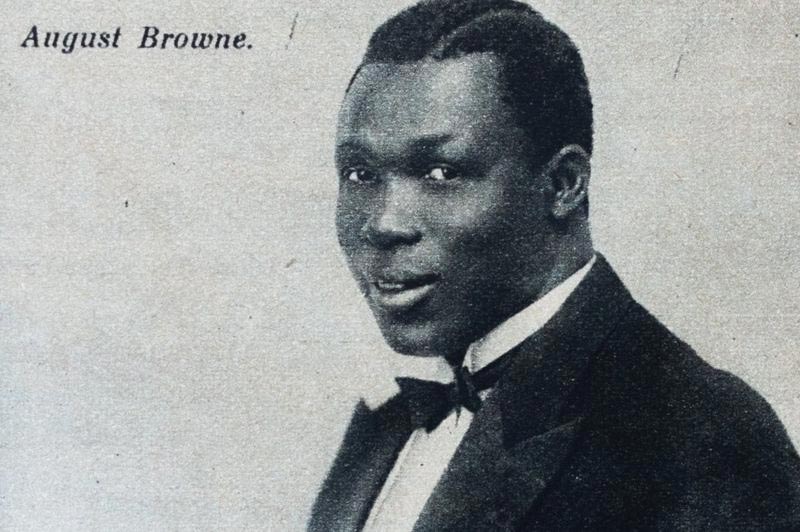
Even without the unproven combat legend, Browne’s story remains impressive. The new facts show him as a remarkable survivor, a Black musician who found his way through the strict social rules of interwar Warsaw, lived through the Nazi occupation, and managed to survive against the odds. This is the true story of August Browne, focusing on his real journey in Poland and later life in London.
From Lagos to the Capital of Polish Jazz
August Browne was born on 22 July 1895 in Lagos, Nigeria, which was then part of the British Empire. His parents were Wallace and Josefina. In 1922, he left Nigeria and first arrived in Britain as a stowaway on a merchant ship. As a British imperial citizen, he could enter legally, but he wanted to go further east. Later that year, he moved to Poland, lived for a short time in Gdańsk and Kraków, and then settled in Warsaw.
In the lively and creative world of interwar Warsaw, Browne built a successful career:
- Professional Musician: He found steady work as a talented jazz drummer.
- Fordanser: He was employed as a professional male dance partner hired by upscale venues to dance with unescorted female patrons.
- Social Integration: He became a regular at Warsaw’s top nightspots, such as the Mała Ziemiańska restaurant also known as the Winiarnia Ziemiańska, especially its basement club, the Caveau Caucasien, also called Piwnica Kaukaska.
- Film actor: He stared in cameo roles in 1936 (Papa się żeni) and 1953 (Żołnierz zwycięstwa).
The short film clip above from the film Papa się żeni, shows August Browne in the cameo role of a banjo player.
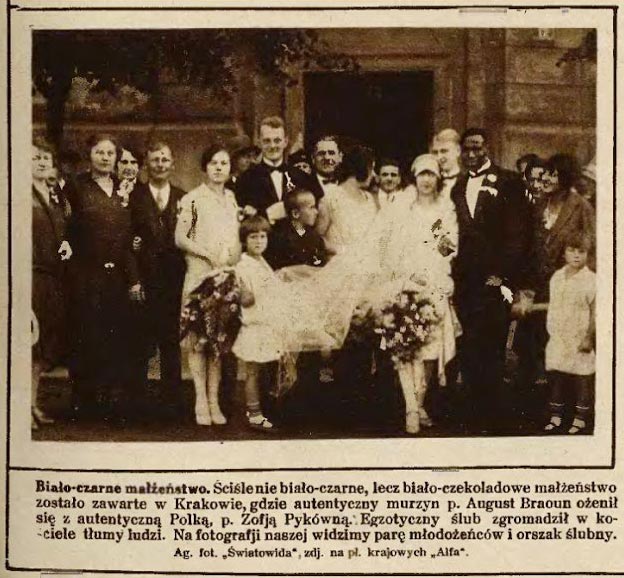
August Browne became part of Polish society. He married a Polish woman, Zofia Pykówna, in Kraków in 1927, and they had two sons, Ryszard and Aleksander.
A Witness to High Society Drama: The 1933 Stawiński Trial
August Browne appears as a key witness
Although many people saw August Browne’s pre-war life as focused on entertainment, old Polish newspapers show that Browne held a unique social position and sometimes found himself involved in important public events.
In May 1933, Browne was a key witness in a dramatic court case that caught Warsaw’s attention. The trial was about Major Jerzy Stawiński, who shot and killed a well-known engineer, Adam Jankowski, after a heated argument at the Piwnica Kaukaska. Browne was working on the dance floor that night, so he saw the events unfold up close.
When Browne testified before the court, his presence made a big impression. The newspaper Nowy Czas reported on 12 May 1933 that Browne spoke Polish with some difficulty but understood everything clearly. He gave important and confident testimony that challenged the Major’s self-defense claim, describing how Major Stawiński left his wife on the dance floor to confront and slap Jankowski over a social insult.
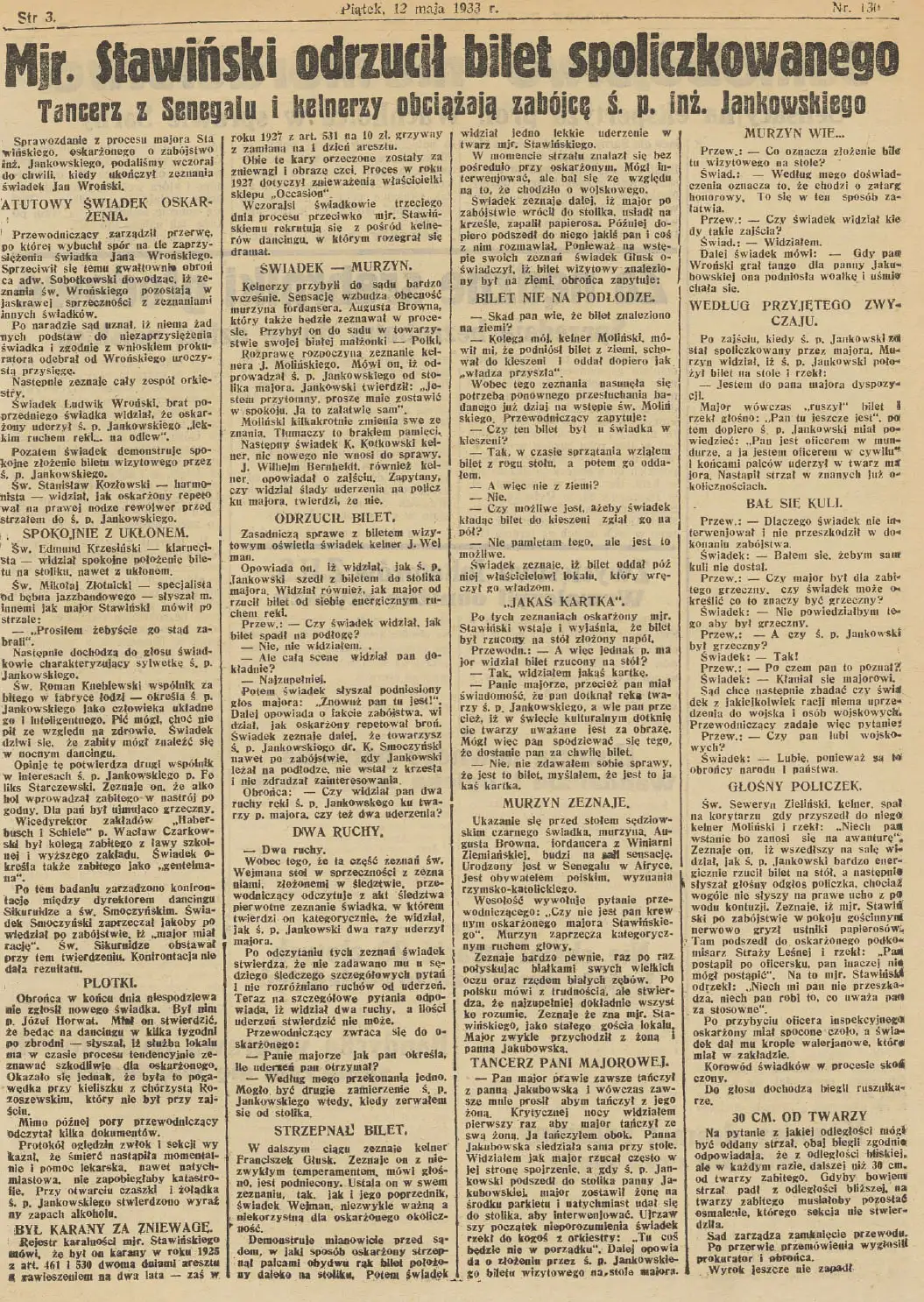
Source: Nowy Czas. 12 May 1933. P3. Jagiellonian Digital Library.
When the judge later asked August Browne if he harboured any prejudice against the military, Browne diplomatically replied:
“I like them, because they are the defenders of the nation and the state.”
This court case gives us a rare, factual look at Browne’s life before the war. It shows he was respected and trusted in the community, and that his words mattered in an important legal case.
Newspaper Report
August Browne’s Complete Court Testimony
Content Note: This historical court report contains language, including racial descriptions and slurs, that reflects the racial prejudices of the pre-WWII era. I have retained the original newspaper wording for the sake of historical accuracy, but some of this language is offensive and does not reflect modern values.
Report: Nowy Czas (12 May 1933)
Read the original Polish transcript here
English Translation
THE BLACK MAN TESTIFIES
The appearance before the judicial bench of the black witness, a Negro named August Browne, a fordanser from the Winiarnia Ziemiańska, causes a sensation in the courtroom. He was born in Senegal, Africa. He is a Polish citizen of the Roman Catholic faith.
Amusement is sparked by the presiding judge’s question: “Are you perhaps a relative of the accused, Major Stawiński?”. The Black man denies it with a categorical shake of his head.
He testifies very confidently, flashing the whites of his large eyes and a row of white teeth from time to time. He speaks Polish with difficulty but asserts that he understands absolutely everything perfectly. He testifies that he knows Major Stawiński as a regular patron of the establishment. The Major usually came with his wife and Miss Jakubowska.
THE MAJOR’S WIFE’S DANCING PARTNER
“The Major almost always danced with Miss Jakubowska, and on those occasions, he always asked me to dance with his wife. On the critical night, it was the first time I saw the Major dancing with his own wife. I was dancing right next to them. Miss Jakubowska was sitting alone at the table. I saw the Major casting frequent glances in her direction, and when the late Mr. Jankowski approached Miss Jakubowska’s table, the Major left his wife stranded in the middle of the dance floor and immediately went to the table to intervene.”
Having sensed the beginning of the misunderstanding, the witness said to someone in the orchestra: “Something is not going to be right here.” He further recounts the late Mr. Jankowski placing a visiting card on the Major’s table.
THE BLACK MAN KNOWS…
Presiding Judge: — What does placing a visiting card on the table mean? Witness: — In my experience, it means that it concerns a dispute of honour. That is how things are settled. Presiding Judge: — Has the witness ever seen such incidents before? Witness: — I have.
The witness further states: — When Mr. Wroiński was playing a tango for Miss Jakubowska, she lifted her veil and smiled.
ACCORDING TO ESTABLISHED CUSTOM
After the incident, when the late Mr. Jankowski was slapped by the Major, the Black man saw that the late Mr. Jankowski placed his card on the table and said: “I am at the Major’s disposal.”
The Major then “brushed aside” the card and said loudly: “Are you still here?”, only after which the late Mr. Jankowski was said to have replied: “You are an officer in uniform, and I am an officer in civilian clothes,” and struck the Major in the face with his fingertips. The shot followed under the already known circumstances.
HE WAS AFRAID OF THE BULLET
Presiding Judge: — Why did the witness not intervene and prevent the killing from taking place? Witness: — I was afraid that I would catch a bullet myself. Presiding Judge: — Was the Major polite to the deceased, or can the witness define what it means to be polite? Witness: — I would not say that he was polite. Presiding Judge: — And was the late Mr. Jankowski polite? Witness: — Yes! Presiding Judge: — How could you tell? Witness: — He bowed to the Major.
The court then wishes to examine whether the witness holds any prejudice against the military or military personnel for any reason. The presiding judge therefore asks the question: Presiding Judge: — Do you like military men? Witness: — I like them, because they are the defenders of the nation and the state.
Note: The newspaper (or the court) wrongly identifies August Browne’s country of origin as Senegal.
(Note: The article concludes with testimony from waiters confirming the events, followed by gunsmith experts confirming the shot was fired from a close distance, but further than 30 cm.)
Raport prasowy – Proces majora Jerzego Stawińskiego
Pełne zeznania sądowe Augusta Browne’a
Uwaga dotycząca treści: Poniższa historyczna relacja sądowa zawiera język – w tym opisy i określenia rasowe – który odzwierciedla uprzedzenia epoki przedwojennej. Zachowałem oryginalne słownictwo gazety ze względu na wierność historyczną, jednak część z tych sformułowań jest obraźliwa i nie odzwierciedla naszych współczesnych wartości.
Original Polish Report: Nowy Czas (12 May 1933)
MURZYN ZEZNAJE
Ukazanie się przed stołem sędziowskim czarnego świadka, murzyna, Augusta Browne’a, fordancera z Winiarni Ziemiańskiej, budzi na sali sensację. Urodzony jest w Senegalu w Afryce. Jest obywatelem polskim, wyznania rzymsko-katolickiego.
Wesołość wywołuje pytanie przewodniczącego: „Czy nie jest pan krewnym oskarżonego majora Stawińskiego?”. Murzyn zaprzecza kategorycznym ruchem głowy.
Zeznaje bardzo pewnie, raz po raz połyskując białkami swych wielkich oczu oraz rzędem białych zębów. Po polsku mówi z trudnością, ale stwierdza, że najzupełniej dokładnie wszystko rozumie. Zeznaje że zna mjr. Stawińskiego, jako stałego gościa lokalu. Major zwykle przychodził z żoną i panną Jakubowską.
TANCERZ PANI MAJOROWEJ
— Pan major prawie zawsze tańczył z panną Jakubowską i wówczas zawsze mnie prosił abym tańczył z jego żoną. Krytycznej nocy widziałem pierwszy raz aby major tańczył ze swą żoną. Ja tańczyłem obok. Panna Jakubowska siedziała sama przy stole. Widziałem jak major rzucał często w jej stronę spojrzenia, a gdy ś. p. Jankowski podszedł do stolika panny Jakubowskiej, major zostawił żonę na środku parkietu i natychmiast udał się do stolika, aby interwenjować. Ujrzawszy początek nieporozumienia świadek rzekł do kogoś z orkiestry: „Tu coś będzie nie w porządku”. Dalej opowiada o złożeniu przez ś. p. Jankowskiego biletu wizytowego na stole majora.
MURZYN WIE…
Przew.: — Co oznacza złożenie biletu wizytowego na stole? Świadek: — Według mego doświadczenia oznacza to, że chodzi o zatarg honorowy. To się w ten sposób załatwia. Przew.: — Czy świadek widział kiedy takie zajścia? Świadek: — Widziałem.
Dalej świadek mówi: — Gdy pan Wroiński grał tango dla panny Jakubowskiej ona podniosła woalkę i uśmiechała się.
WEDŁUG PRZYJĘTEGO ZWYCZAJU
Po zajściu, kiedy ś. p. Jankowski został spoliczkowany przez majora. Murzyn widział, iż ś. p. Jankowski położył bilet na stole i rzekł: — Jestem do pana majora dyspozycji.
Major wówczas „ruszył” bilet i rzekł głośno: „Pan tu jeszcze jest”, po tem dopiero ś. p. Jankowski miał powiedzieć: „Pan jest oficerem w mundurze, a ja jestem oficerem w cywilu” i końcami palców uderzył w twarz majora. Nastąpił strzał w znanych już okolicznościach.
BAŁ SIĘ KULI
Przew.: — Dlaczego świadek nie interwenjował i nie przeszkodził w dokonaniu zabójstwa. Świadek: — Bałem się, żebym sam kuli nie dostał. Przew.: — Czy major był dla zabitego grzeczny, czy świadek może określić co to znaczy być grzeczny? Świadek: — Nie powiedziałbym tego aby był grzeczny. Przew.: — A czy ś. p. Jankowski był grzeczny? Świadek: — Tak! Przew.: — Po czem pan to poznał? Świadek: — Kłaniał się majorowi.
Sąd chce następnie zbadać czy świadek z jakiejkolwiek racji niema uprzedzenia do wojska i osób wojskowych. Przewodniczący zadaje więc pytanie: Przew.: — Czy pan lubi wojskowych? Świadek: — Lubię, ponieważ są to obrońcy narodu i państwa.
Uwaga: Gazeta błędnie podaje, że krajem pochodzenia Augusta Browne’a jest Senegal.
(Uwaga: artykuł kończy się zeznaniami kelnerów potwierdzającymi zdarzenia, po których następuje relacja ekspertów z zakresu rusznikarstwa, potwierdzających, że strzał został oddany z bliskiej odległości, ale większej niż 30 cm.)
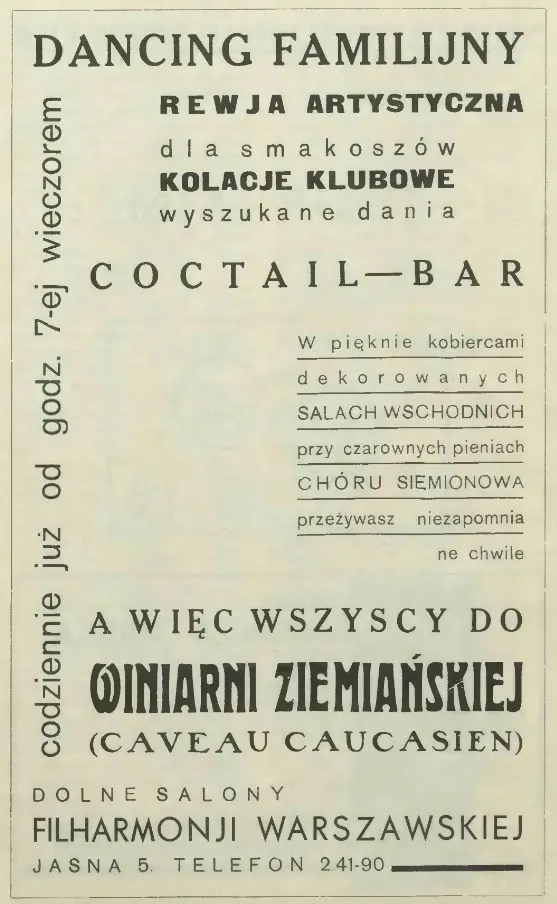
The associated scan shows a newspaper advertisement for the Winiarnia Ziemiańska, also known as the Caveau Caucasien, in Warsaw.
Source: Monthly published by The Society For The Promotion Of Theatre Culture in Poland. January 1935. P16. Archived at the Mazowiecka Digital Library.
The location is where August Browne was working on the night of the murder.
The Riddle of Wartime Survival
When World War Two began in September 1939, Browne faced a difficult decision. As a British citizen, he managed to get his wife and young sons safely to the UK. But he chose to stay in occupied Warsaw.
How Browne, as a Black man, survived nearly six years in Nazi-occupied Europe is still one of the biggest mysteries of his life. At that time, everyone needed to carry a Kennkarte, or identification card, to move around legally.
In an important article for Notes from Poland, historian Dr Nicholas Boston shared that Browne’s original Kennkarte was found in the UK National Archives. It includes his photo, fingerprints, and a description by Nazi officials: “Schwarze Gesichtsfarb” (black complexion). Experts say this is the only known Kennkarte for a Black person in occupied Poland that exists in a public archive.
To get by during the occupation, Browne:
- Taught foreign languages to private clients.
- Traded in electronic equipment on the secondary market.
However, the details of his later wartime years are unclear because of his own conflicting stories. In 1949, Browne applied to join the Polish veterans’ association (ZBoWiD), saying he fought in the 1944 Warsaw Uprising under the name “Ali.” But many years later, a very different story came out.
The Compensation Claim
Circles of Hell
In the mid-1960s, the British government established a scheme to distribute compensation payments to British victims of Nazi persecution, funded by the Anglo-German Compensation Agreement of 1964.
Dr Boston’s research unearthed Browne’s formal 1964 compensation application. In it, Browne made a statutory declaration that directly contradicted his earlier claims of fighting in the Uprising:
“In 1939, when the Germans occupied Poland, I, as a Negro, was not allowed to leave the country. On May 10th, 1940, I was interned in the Treblinka concentration camp and remained there until October 10th, 1944…”
Historians like Jan Grabowski have pointed out that this story does not add up. There are no records or survivor accounts of a Black man at Treblinka, and the dates Browne gave do not match the camp’s history.
However, Browne did have clear proof that he was held in the transit camps of Pruszków and Radomsko late in the war. A certificate from the Polish Relief Committee in Radomsko shows he was under their care in October 1944, after being evacuated from Warsaw with thousands of other civilians when the Warsaw Uprising ended.
Given the questions about Treblinka, why was his claim accepted? To get the money, Browne had to pass strict medical exams by British government doctors. The records showed he had serious, long-term health problems caused by mistreatment and malnutrition during his time in camps.
The British authorities approved his claim and awarded him £2,385 (about £59,000 today). As Professor Grabowski said, Browne had clearly been through his own “circles of hell” during the occupation, and like many survivors, he used the options he had to get important financial help in his later years.
Later Life in the UK
In 1958, when Poland was under communist rule, August Browne moved to the United Kingdom and settled in London. He had previously married again in Poland, to a Polish woman named Olga Miechowicz, and they had a daughter named Tatiana, who was born in London.
In London, Browne went back to his passion for music and worked mostly as a session musician. But by the late 1960s, when he got his compensation money, his health was poor and he had little session work. He spent his last years quietly, living on the compensation and earning extra by teaching private piano lessons at home.
August Browne died in London on 8 August 1976 at the age of 81. He is buried there. His legacy is not a made-up military story, but the real story of a man who used his intelligence, resilience, and talent for survival to make it through one of the darkest times of the twentieth century.
Key Sources for Further Reading:
- Dr Nicholas Boston’s detailed archival breakdown: Notes from Poland. 2025.
- Original 1933 trial coverage (part) : Nowy Czas newspaper. 1933. P3. In Polish.
- Original post about August Brown on this website.
Author’s Note: Did You Frequent Ognisko Polskie in the 1970s?
As a personal footnote to this story, during the early 1970s, I regularly frequented the Ognisko Polskie (Polish Hearth Club) in Kensington, London. On Friday evenings, a highly professional group of Black musicians used to play easy-listening music in the bar. Given Browne’s deep, lifelong ties to the Polish community, his residency in London, and his need for session work in his later years, I often wonder if the quiet, professional drummer we enjoyed so much on those Friday nights was August Browne himself, playing out his final years in the comfort of a language and culture he had adopted fifty years prior.
I am very keen to hear from anyone who might be able to shed light on this. If you frequented the Kensington club in the early 1970s, remember this music group, or have any information regarding where August Browne performed in London during his later years, please get in touch.
You can share your memories or comments about any aspect of this post in the comments section below, or reach out to me privately via my Contact Page. Any details, no matter how small, would be greatly appreciated.
Subscribe to future posts on this website by email. No spam, just an email when a new post is published. View the posts.
See my explainer titled “What is Substack“.
Posts tagged with Poland. See all in Poland.
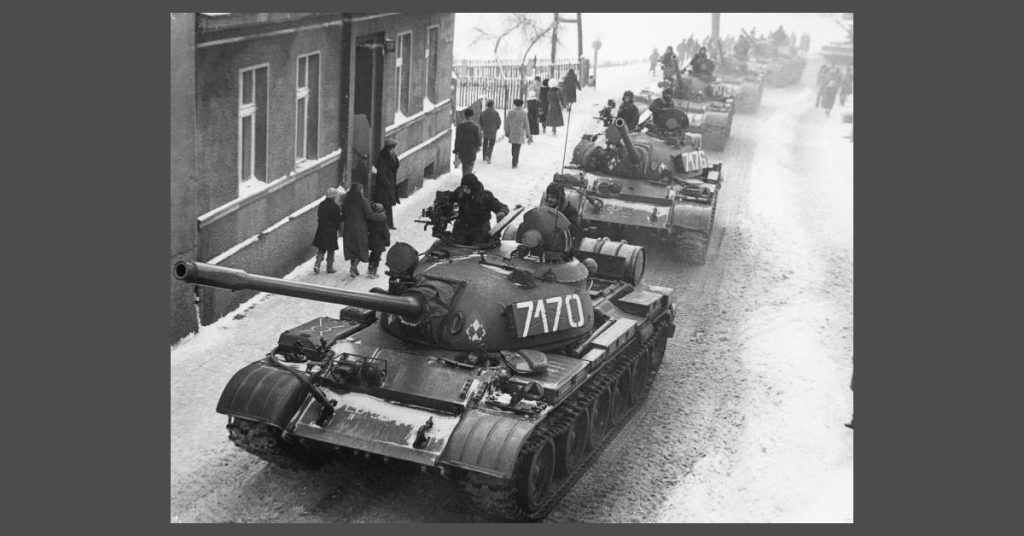
Operation Azalea: The Night Poland Lost Its Telex and Phone Connections
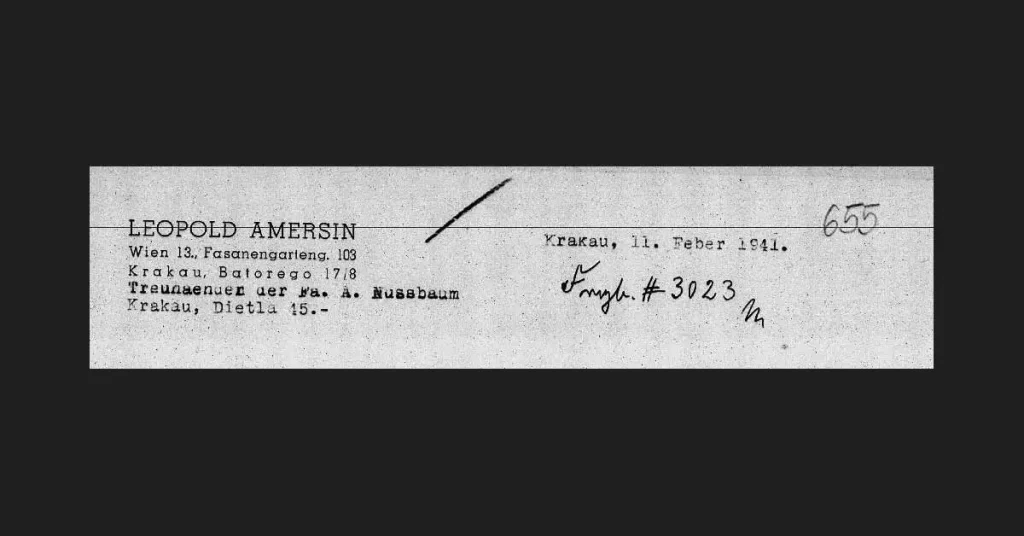
Leopold Amersin: A Treuhänder in Occupied Kraków
Tracing A Name Through Occupied Kraków: Mala Englard