Aniela Szkawran’s WWII Paper Trail
From the Polish Border Guard to the WWII German Post Office
Family history is usually kept in fragments, such as a photograph, a memory, or a story. Recently, though, I have been able to piece together a very accurate and date-supported account of my mother’s life during the Second World War thanks to the recent discovery of a small set of WWII identification documents and stamp folders in a suitcase.
The papers belonging to Aniela Szkawran (1919 – 2014) record the experience of a private individual as she passed through the Polish administrative system before the war, suffered the shock of the German invasion in 1939, and had to endure work and and compulsory evacuation during the German occupation.
The Foundation: Cieszyn (1936)
Państwowa Szkoła Handlowa (State Commercial School) in Cieszyn
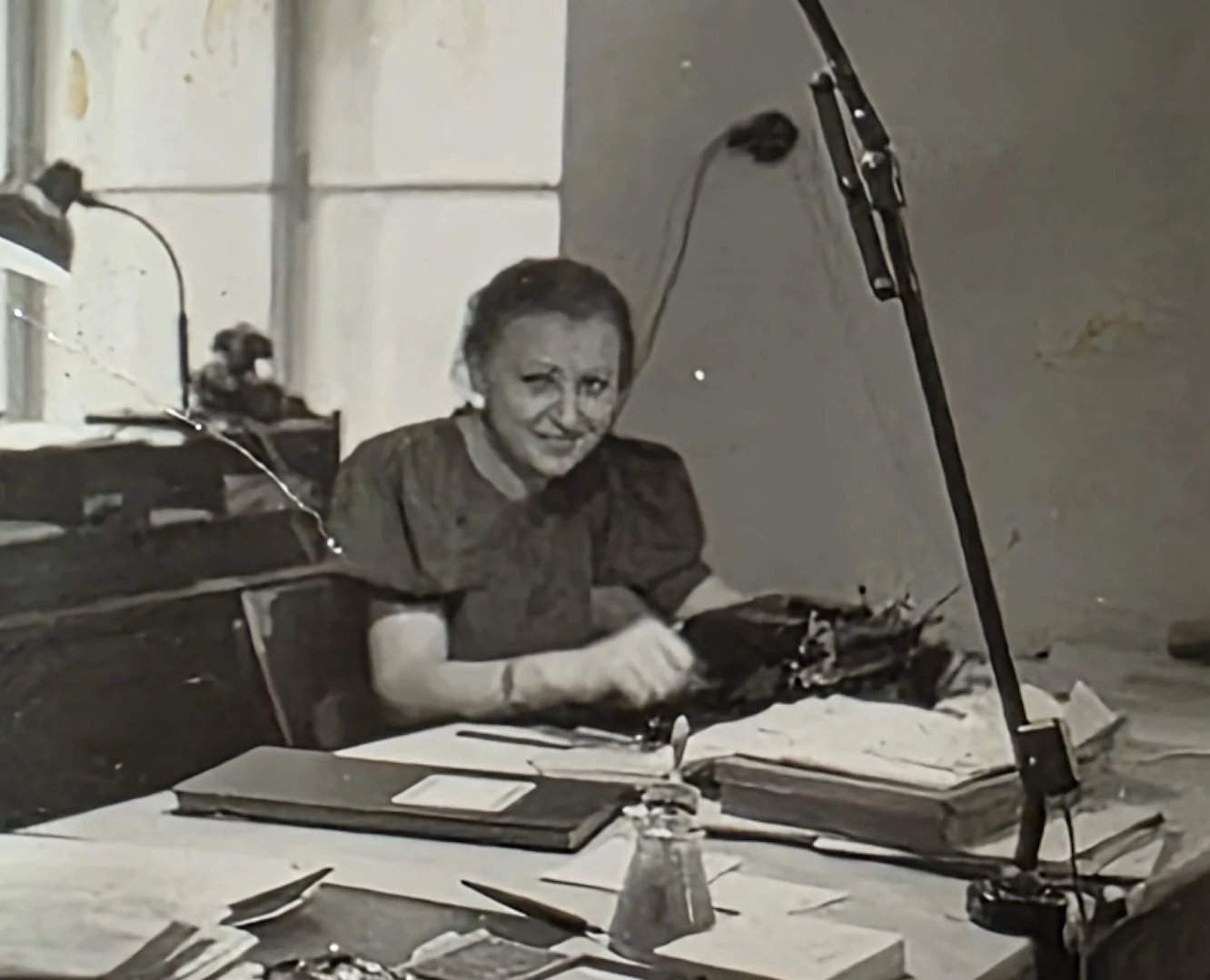
The abilities which eventually enabled Aniela to survive the war were developed in the mid-1930s. In 1936 she completed her studies in Class III.B at the Państwowa Szkoła Handlowa (State Commercial School) in Cieszyn. The education she received provided her with solid administrative training, excellent typing skills, and fluency in German.
A photograph (from her later employment with the German Post Office) shows her sitting firmly at a heavy office typewriter, and fully illustrates the professional ability she acquired at that time.
The outbreak of war
According to her official Work Card, Aniela was employed from 1 May 1938 as a Civilian Contract Worker (Pracowniczka kontraktowa) by the Greater Poland Regional Inspectorate of the Border Guard (Wielkopolski Inspektorat Okręgowy Straży Granicznej), and she was based in the western border town of Wolsztyn, where she worked as a clerical worker.
The position came to an abrupt end on 1 September 1939. As the German forces carried out the invasion, the uniformed Polish border guards would have been at once absorbed into the regular armed forces. Civilian contract workers such as Aniela were in effect cut off from their employer. In accordance with the emergency procedures, the station’s administrative files would also have been destroyed, and the civilian workers were entrusted with state funds (to be returned to the state after the war ended) before being forced to evacuate eastward on their own, joining the chaotic flows of the millions of refugees.
Unemployment in occupied Kraków (Spring 1940)
According to her Meldekarte (Labour Office Registration Card), by early 1940 Aniela had moved to occupied Kraków. The document shows that she was required to report weekly to the German Labour Office during March and April 1940, and on 18 April there appeared a blue stamp which stated simply: Arbeitslos (Unemployed).
Employment with the German Post Office
Her period of unemployment came to an end on 1 July 1940, since her clerical abilities and knowledge of the German language secured her an appointment with the WWII German Post Office. She was formally engaged by the Head of the Deutsche Post Osten Krakau (German Post East Kraków).
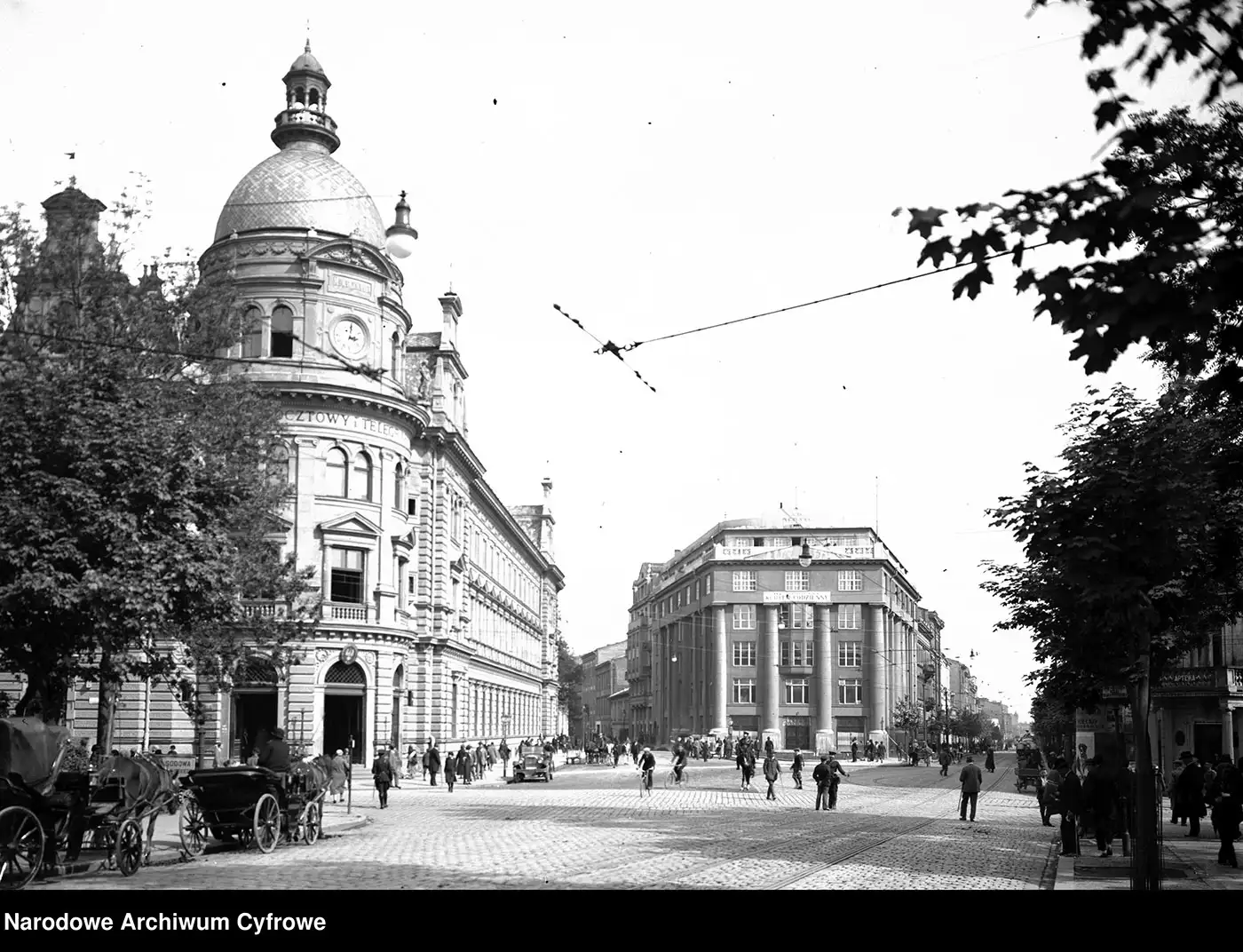
Her documents, which include a Kennkarte and a Personalausweis (Identity Card for Non-German Administration Employees), list her position as a Angestellte (salaried worker) assigned to Postamt 3, (likely the main Post Office at 2 Wielopole Street. Source: Muzeum Dulag 121) and also show that she later lived at ulica św. Sebastiana 18, apartment 4. The Personalausweis has rolling extension stamps indicating that she had continuous employment right up to 30 September 1944, only a few months before the postal infrastructure started to break down under the advancing Soviet army. (Note: Aniela also worked at a mobile post office in Zakopane during part of that period).
The associated photograph of the main post office (to the left of the photograph) in Kraków dates from 1926.
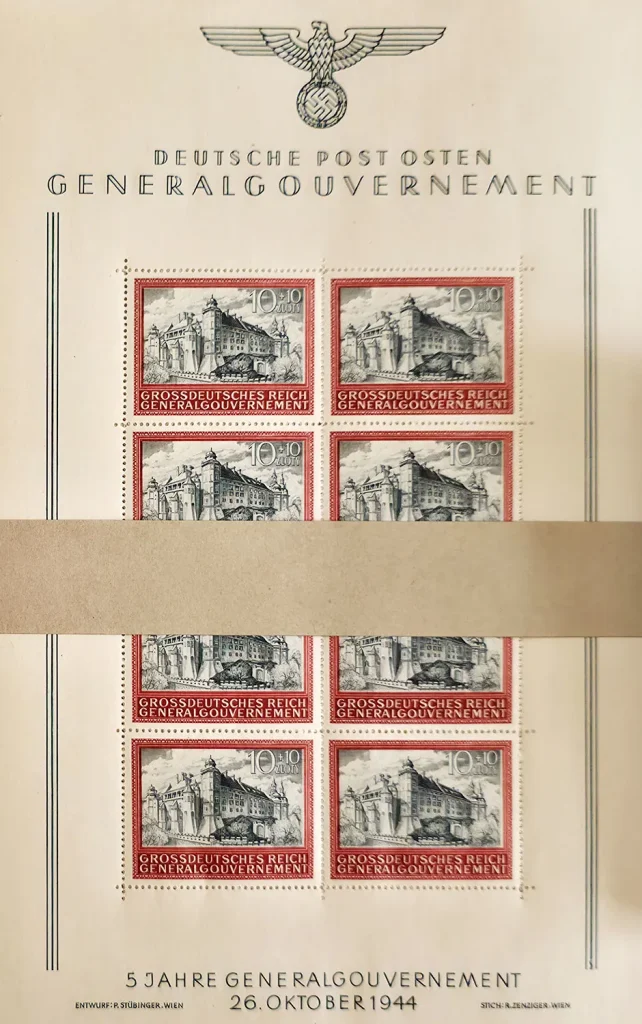
From the late 1944 to the spring of 1945, as the situation on the Eastern Front was collapsing, the German postal staff in Kraków were forced to be evacuated westwards into Germany. Of the items that Aniela took with her in her suitcase were four folders containing pristine, uncirculated stamps (Michel 125, Wawel Castle issues, 10+10 Zloty).
The notes that she has made in these folders indicate that she was not simply packing at random but was instead systematically recording the collapse. She has labelled the folders as the “3rd” and “4th (last) issue”. Stamps from the Staatsdruckerei Wien (the State Printing Office in Vienna) dated November 1944 and March 1945 are printed on the folders.
A scan of the last 4th issue shown in the associated image.
The fact that she has these late-stage materials matches exactly with an remarkable recollection she gave in the 1970s, namely that she was there at the end of things when the retreating German administration destroyed their printing presses and stamp plates.
Note: On 19 March 1945, Adolf Hitler issued the Nerobefehl (Nero Decree). This was a strict scorched-earth policy ordering the total destruction of all German infrastructure, communications, transport, and administrative facilities to prevent them from falling into Allied or Soviet hands. The destruction of postal infrastructure, including archives, date stamp cancellers (defacing of stamps to prevent reuse), printing plates, and uncirculated stamp stock, was a mandatory part of this directive.
Further proof of her records relating to the postal service’s last days can be found on the back of the fourth folder. There, Aniela carefully noted the logistics of the besieged Hel Peninsula on the Baltic coast, writing:
“Deutsche Feldpost durch U-boot” (German Field Post by U-boat) and “z Helu. 1945 Marzec” (from Hel. March 1945).
Aftermath
Aniela survived the evacuation and the war’s end, eventually making her way to the American lines. She navigated the displaced persons (DP) camps at Hof and Langlau in Germany, where she met Aleksander Rodziewicz, a survivor of Stutthof and Buchenwald. After a period in private accommodation in Porto San Giorgio, Italy, they were evacuated by ship to the UK and married in London in 1947.
Your comments are welcome and I look forward to hearing from you in the comments section.
Enjoy reading my commentary? Add South Coast View as a Preferred Source on Google to see new posts first.

Subscribe to future posts on this website by email. No spam, just an email when a new post is published. View the posts.
 Follow on Substack
See my explainer titled “What is Substack“.
Posts tagged with Poland. See all in Poland.
August Browne: The True Story
Operation Azalea: The Night Poland Lost Its Telex and Phone Connections
Leopold Amersin: A Treuhänder in Occupied Kraków