1960s Life in Sunderland
Childhood Memories and Rediscovered Letters (Part 2)
Key Highlights in This Article:
- Location & Era: Fulwell and Roker, Sunderland (Early 1960s).
- Schooling: Memories and historical map of Fulwell Infant and Junior School.
- Primary Sources: Rediscovered family letters and memories detailing 1960s life in Sunderland and daily primary school life.
- Local Landmarks: Roker Beach and memories of the picturesque countryside beyond Sunderland.
You can read Part 1 of this story: From Kensington to JFK at 19 Princes Gate.
This post is featured on South Coast View’s Substack publication.
More Items Came to Light in my Mother’s Suitcase
After discovering my mother’s letters from post-war Kensington, two more items came to light in her suitcase. They date from the early 1960s, when my mother, Aniela, returned to work as a housekeeper for Mr Harvey C. Bishop ARIBA in Sunderland.
Note: My mother previously worked for Mr Bishop in 1947, when the family lived in Brockley, south-east London. I have written about this in Part 1 of this story: From Kensington to JFK at 19 Princes Gate.
Although Mr Bishop was appointed Borough Architect for Sunderland in 1964, records show that he was already working closely with Sunderland Corporation’s architects’ department as early as 1955.
Sources: Harvey C. Bishop
- The Architects’ Journal 1959-10-29-USModernist. (PDF File). Design of the 63 foot high Fire Observation and Practice Tower erected in Sunderland in 1955/56.
- Sunderland Technical College 1964 – Mainstream Modern. 1964. As part of the post-war expansion of Sunderland Technical College, Borough Architect H.C. Bishop oversaw the design of a major building block and campus complex completed in 1964.
- Historic England. Researching Sunderland’s Heritage Action Zone. 14 September 2018. Harvey Bishop introduced the city’s first high-rise housing, radically transforming Sunderland’s skyline with the construction of multi-storey tower blocks across the Coronation Street, Hendon Road, Walton Lane, and Town Central Area developments throughout the 1960s.
The Journey North: Steam, Fatigue, and a Covered Parrot
The move from our home in Mitcham, Surrey, up to Sunderland in the early 1960s began with a long, exhausting journey. After making our way across London to King’s Cross Station, my mother and I boarded a northbound train. In those days, the journey to Sunderland was steam-hauled and typically took between 5 and 5½ hours. For a six-year-old, it felt like forever.
By the time we finally arrived at the Bishop household, having navigated the final leg from Sunderland Railway Station, it was late in the day. Tired and completely overwhelmed by the long trip, I remember us being sat down in their home and fed by Mrs Bishop. Among the hazy memories of that first evening, one detail stands out vividly: a pet parrot sitting in its cage in the corner, covered with a blanket to help it sleep for the night.
1960s Life in Sunderland: The Documents
The newly discovered documents, a typed letter sent to my father in London and a handwritten note from one of Mr Bishop’s teenage daughters, offer a sweet snapshot of a child adapting to a new life in Sunderland.
The Letters: A Six-Year-Old’s View of Life in Sunderland
The first letter (tied with a pink ribbon) was typed on a machine in the Bishop home, dictated by me to Mr Bishop’s daughter, who helped write down my thoughts:
Daddy, Andrew loves you very much… I have some pretty shoes. I am having a lovely time here. I have had my hair cut, it looks very nice. I have been drawing a nice house. This house is very big… They have a scooter with yellow wheels on. They have some cars, one for Mr Bishop and one for Mrs Bishop. The sea is lovely and I even went down to the beach. They have a very nice clock. Mrs Bishop bought mummy a nice cardigan. They have a nice garden. They have a little toy car which I play with. They have a dog whose name is Taffer. I took some paper to school and I draw on it.
Accompanying it was a note written in green ink on circus-themed stationery sent to my father, reassuring him about how I was settling into school:
Dear Mr Aleksander… Thank you for the nice sentence of thank-you. Andrew is getting on quite well, there is a great hope for him if Andrew tries. At least he knows two and two. I will write again and tell you how he is getting on. All my love… PS Look after yourself and don’t be lonely.
Childhood Memories of the North East
My 1960s Life in Sunderland
Reading these notes brought back vivid, scattered memories of our time living in the Bishop household:
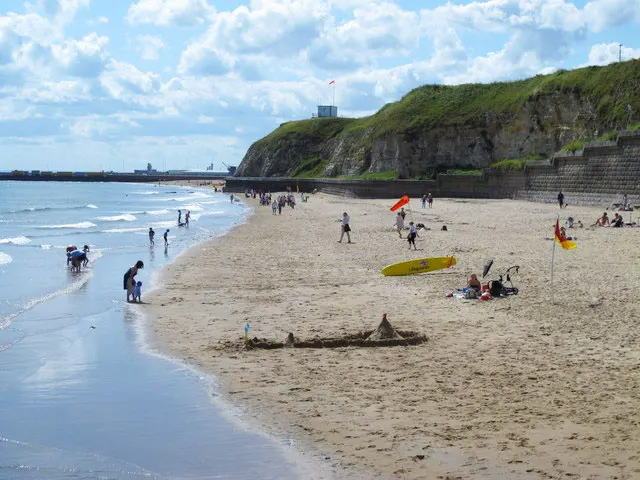
Image: Roker Beach (5) by Mike Quinn, CC BY-SA 2.0, via Wikimedia Commons
- The Pedal Car and the Garden: I distinctly remember the toy car mentioned in the letter, a pedal car I drove around the patio. I also remember standing next to Mr Bishop and singing at the top of my lungs while he gardened. When he warned me that if I didn’t stop singing he would send me away, I carried right on singing, and he promptly sent me inside!
- A Sunny Countryside Bus Stop: Another vivid memory from my 1960s life in Sunderland is a day trip out into the undulating, picturesque countryside outside Sunderland. On a beautiful, sunny day, my mother, the Bishop daughter, and I waited at a rural request stop to catch a bus. As a child keen to help, I wanted to hail the approaching bus myself. However, F___ gently stopped me, advising my mother: “It’s best if Andrzej doesn’t hail the bus, as the drivers don’t always stop when a child hails.” I don’t recall where we were travelling to or from, but that vision of rolling, sunlit North East countryside,and the Bishop daughter’s practical advice, has stayed with me ever since.
- Roker Beach: The letter mentions going down to the beach. My memory of Sunderland beach is vivid, along with the large sewage outlets under the embankment that flowed into the sea.
- Fulwell Infant School in Sunderland: The infant school I attended, which I am near 100% sure was Fulwell Infant School, remains the warmest memory of my childhood. The teachers and children were exceptionally welcoming to a young boy arriving from London with a southern accent, in stark contrast to my later experience at junior school in Leicester.
- I recall a forbidden passage in the Sunderland playground that was the dividing line between the infants and junior playgrounds, and an eagle-eyed teacher gently catching me when I ventured inside. I distinctly remember protesting to the teacher, saying: “I am going to Poland!” Another vivid memory from the school gate at “going home time” still makes me smile: while standing outside waiting to be collected, I struck up a conversation with another boy. We exchanged descriptions of our mothers, and I hit upon what I thought was a stroke of absolute childhood genius: “You look out for my mother, and I’ll look out for yours!” How that tactical arrangement actually played out in practice remains lost to time, but I have no doubt both our mothers successfully retrieved us in the end.
Map of Fulwell Infant School in Fulwell, Sunderland
Dating from from 1946
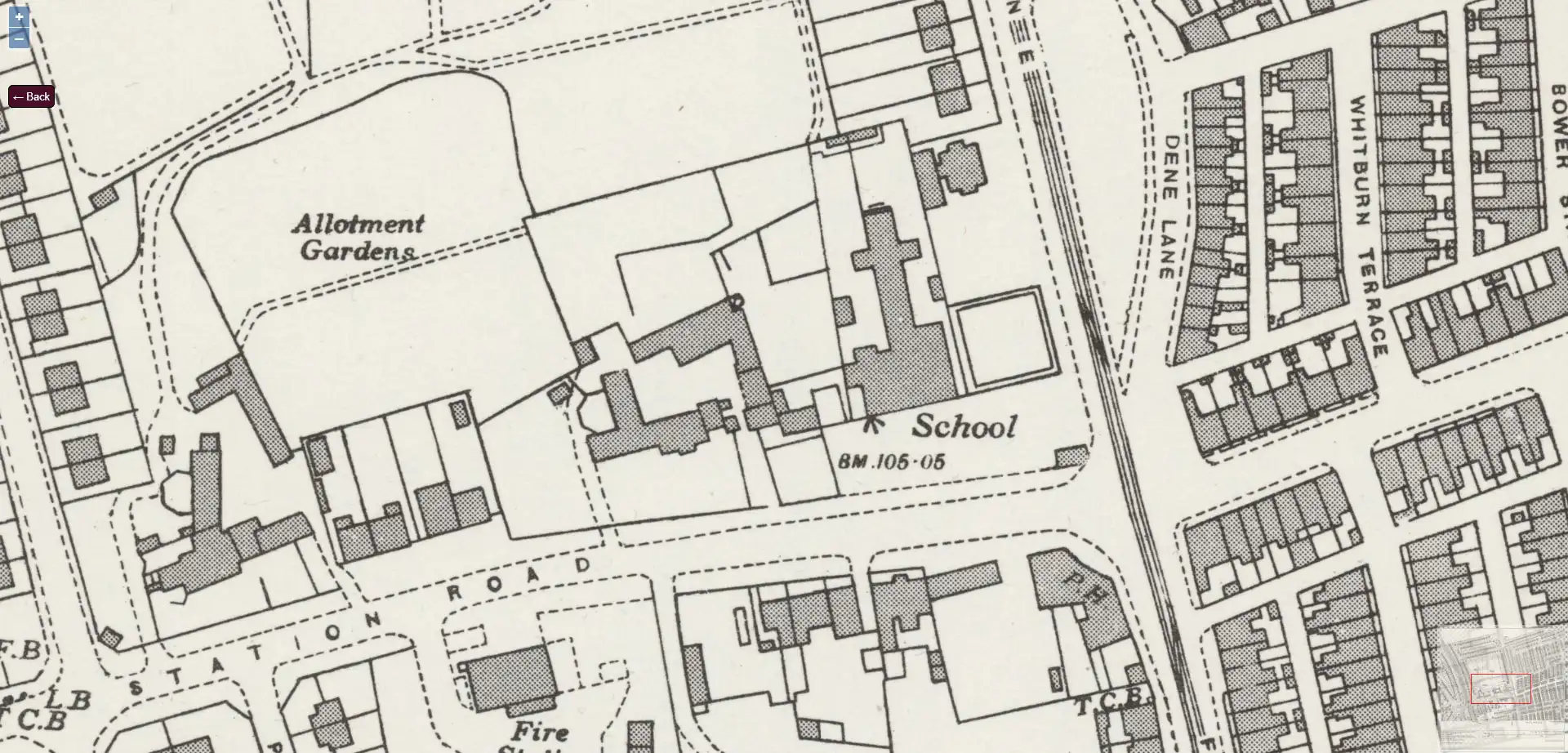
Map link for Fulwell School and image attribution
- Map location of Fulwell Infant School at the National Library of Scotland.
- Reproduced with the permission of the National Library of Scotland. CC-BY (NLS).
The above map gives me a clearer picture of how this school looked like at the time I attended. To view the old Fulwell infant school, you will need to zoom in and look for Station Road to the south of the building marked on the map as School. The school was opposite The Blue Bell pub, marked as PH on Station Road.
Does anyone remember me from around 1960? I was known as Andrew. I would be delighted to hear from you in the comments section or via my Contact Page.
My 1960s Life in Sunderland Took an Unusual Twist
My brief time attending infants school in Sunderland unexpectedly linked back to me decades later. During the investigation into the notorious “Wearside Jack” hoax, the fake tape recordings that derailed the Yorkshire Ripper enquiry, detectives cross-referenced records to find men who had lived in Sunderland.
As my early school attendance in Sunderland had triggered a database hit, I was invited in for an interview at Mitcham Police Station, Surrey. The officer looked at my handwriting, listened to my accent, took a set of fingerprints and very quickly concluded I had nothing to do with the hoaxer or killer. He told me he would report up the chain that my file should be closed.
These brief fragments from an old suitcase complete the story of our family’s long connection with the Bishop family. This bond began in Brockley in 1947, and extended to a high garden on a hill in Sunderland fifteen years later.
My 1960s Life in Sunderland – Were You Part of This Story?
- Are you F___ (one of the Bishop daughters) who lived in Sunderland in the early 1960s, wrote to my father, and helped a six-year-old dictate letters?
- Are you the boy I waited with outside the school when we hatched our “brilliant” plan to look out for each other’s mothers?
- Do you have memories of Fulwell Infant school with the large playground passageway?
If any of this rings a bell, I would love to hear from you. Please feel free to leave a comment below, or drop me a private message via my Contact Page.
Further Reading and Watching: Sunderland Antiquarians Society
Further Reading: Sunderland History and Memories Facebook Group
https://www.facebook.com/groups/637805219573548
Frequently Asked Questions: 1960s Life in Sunderland & Fulwell Infant School
Enjoy reading my commentary? Add South Coast View as a Preferred Source on Google to see new posts first.

Subscribe to future posts on South Coast View by email. No spam, just a notification when a new article is published.
Having trouble confirming? Read my subscription guide.
 Follow on Substack
See my explainer titled “What is Substack“.
A selection of featured posts. View all posts.

The 1601 Józefowo Inheritance: Rodziewicz Family History & Roots
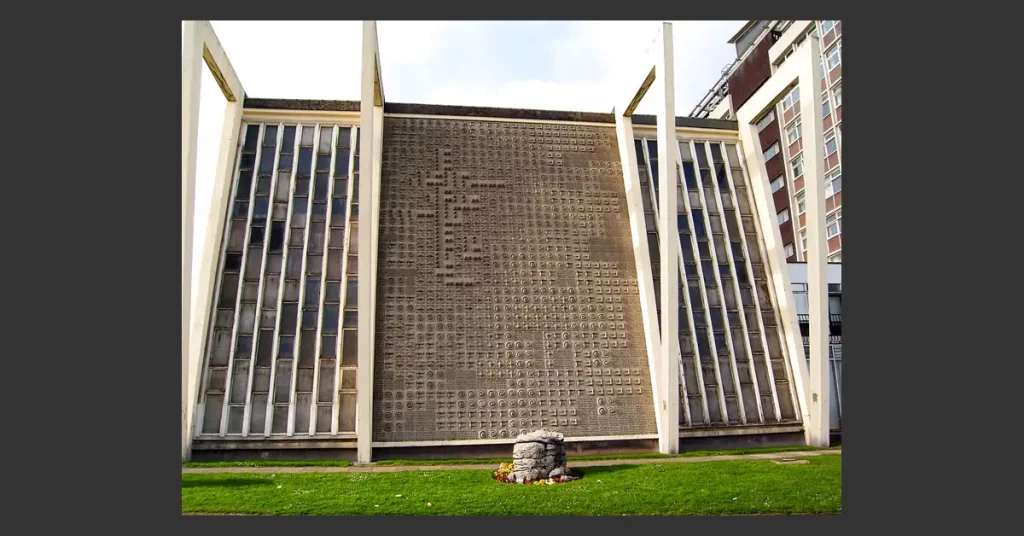
Harvey C. Bishop: The Modernist Visionary Who Reshaped Sunderland’s Skyline

Ukraine UAV Fundraiser: Urgent Appeal