From Kensington to JFK at 19 Princes Gate
My Mother’s Story in Forgotten Letters (part 1)
You can read Part 2 of this story: 1960s Life in Sunderland: Childhood Memories & Rediscovered Letters.
A recent search of a family suitcase led to the discovery of several letters and documents from the late 1940s. These documents show the early stages of my mother, Aniela Szkawran (1919–2014), as she built up her new life in post-war London. They offer personal insight into Polish refugees of that period, reveal an unexpected connection with high society and a remarkable female explorer, and include a visit from a young John F. Kennedy.
The Letters and the Timeline
After my mother arrived in England in 1946, she took a job as a housekeeper in London, and the surviving letters record her movements during her first two years in the country.
- From January 1947 to August 1947, she worked as a housekeeper for Mr Harvey C. Bishop at 21 Adelaide Avenue, Brockley, London SE4.
- From August 1947 to April 1948, she worked as a housekeeper for Mrs Violet Fisher at 19 Princes Gate, Kensington, London SW7.
- From April 1948 to December 1948, she was once again working for Mr Harvey C. Bishop in Brockley.
19 Princes Gate and Violet Cressy-Marcks
The house at 19 Princes Gate in Kensington, London is directly linked to a well-known mid-20th-century home; the employer, known in official documents as Mrs Francis Fisher and in social circles as Mrs Violet Fisher, was Violet Olivia Cressy-Marcks (1895–1970).
Violet Cressy-Marcks was a world traveller, explorer, and war correspondent who reported on both the Spanish Civil War and the Second Sino-Japanese War; in 1931 she married Francis (Frank) Edwin Fisher and kept her main residence in London at Princes Gate, along with their country house, Hazelwood House in Kings Langley, Hertfordshire.
Princes Gate was also a suitable place for a Polish immigrant who had just arrived, since the street was a centre of post-war Polish exile life, with number 19 situated next to the Sikorski Institute at 20 Princes Gate, and close to the Ognisko Polish Club in Exhibition Road.

Princes Gate in Kensington image attribution: Kerim44, CC BY 3.0 via Wikimedia Commons.
Photo Gallery of the Documents


The documents shown above are from the Rodziewicz family archive. No Reuse.
Transcriptions of the documents
1. A letter written by Mr Harvey Bishop to Mrs Francis Fisher (about August 1947)
This composite record contains a reference from Harvey Bishop at the top and a reassuring message to Aniela’s mother in Poland at the bottom:
19 PRINCES GATE, S.W.7
TELEPHONE: KENSINGTON 5960
From Mr. Bishop to Mrs Francis Fisher of above address
Dear Madam,
“Nella”, as we fondly call Aniela Szkawran, has been with us as housekeeper since she came to England some six months ago. I can give her no higher praise than to say that she goes at her own request and leaves a gap here which no one will be able to fill quite so adequately.
As a testimonial to her character, honesty, loyalty and ability I would state that should she wish to return to us at any time she would be more than welcome.
Yours faithfully, (signed Harvey Bishop)
From Mrs Fisher to Nella’s Mother
Nella has been here only one day but I and my family (Husband and two little boys now on holiday) all are delighted that she is taking care of us, she has tackled the situation here (which has never been more difficult as our Grig has stopped working and the daily maids didn’t turn up) extremly ably and shows clearly that she is prepared to take the rough with the smooth, a great asset these days.
Please do not worry about Nella. I will do my best to make her happy and look after her health and comfort to the best of my ability, we are next door to the Polish Institute [Sikorski Institute] and always if she desires she can meet and talk to Polish people from that house.
Yours faithfully, Violet Fisher
Note: “Grig” is almost certainly a typewriter typo for ‘Frig’ (the period’s common term for a Frigidaire refrigerator), as the letters F and G sit next to each other on a standard keyboard.
2. A reference letter by Violet Fisher (24 April 1948)
19 PRINCES GATE, S.W.7
April 24th 1948
Nella Szkawran has been with me for nine months. She is very honest in every way – is clean in her work – very capable & has very nice friends.
Every weekend she has been left alone in the house & I’ve been away over four months (apart from weekends) out of this period, & she was very loyal in looking after my interests. I should be very pleased to speak for her at any time.
Violet Fisher
3. A reference letter by Harvey C. Bishop ARIBA (4 December 1948)
21 Adelaide Avenue, Brockley S.E.4.
4th December, 1948.
To whom it may concern.
This is to certify that Mrs. Aniela Rodziewicz [my mother is now using her married name] has been in my employ as house-keeper from January to August 1947 and from April to 4th December 1948.
She leaves at her own request and I shall be glad to supply any references required by anyone wishing to employ her.
Harvey C. Bishop ARIBA
Clarification: Are Mrs Violet Fisher and Mrs Francis Fisher the same Person?
Yes, they are the same person. In formal 20th-century social etiquette, married women were frequently addressed using their husband’s first name, in this case, her husband, Francis (Frank) Edwin Fisher, making her formally Mrs Francis Fisher. Her given name was Violet (born Violet Olivia Cressy-Marcks, a noted explorer and travel writer), and she signed personal correspondence and references simply as Violet Fisher or V. Fisher. Both names refer to the same individual, who resided at 19 Princes Gate, London, and Hazelwood House in Kings Langley, Hertfordshire.
Cooking for John F. Kennedy
When my mother worked at 19 Princes Gate, an unforeseen incident occurred that she remembered for many years afterwards. On one of her first days with the Fisher family, just as Mrs Fisher had noted about the broken “Grig” and the daily staff being absent, a gathering occurred, and the usual chef did not turn up, so my mother was asked to prepare the meal.
One of the guests at 19 Princes Gate that day was a young member of Congress from Massachusetts, John F. Kennedy, who was 30 years old.
In September 1947, while Kennedy was serving his first term in the U.S. House of Representatives, 13–14 Princes Gate had been the residence of the U.S. Ambassador during his father Joseph P. Kennedy’s time in office (1938–1940). The family had kept close ties with people in the surrounding area. Although a crisis hit the kitchen, the emergency meal proved a success.
Sixteen years later, in June 1963, President John F. Kennedy made an official visit to the UK to meet Prime Minister Harold Macmillan. As his motorcade travelled along Talgarth Road in Hammersmith on its way into Central London, my mother stood in the crowd holding me up to watch him pass, a quiet full-circle moment connecting a Kensington kitchen in 1947 to world history in 1963.
The Bishop Connection and Later Years
My mother maintained a professional relationship with the Bishop family for years. After her second term in Brockley ended in December 1948, she kept in contact with them. When the Bishop family moved north to Sunderland in the early 1960s, she went back to work for them as housekeeper, and I went with her, spending about a year in the Bishop household and attending infant school in Sunderland.
Family Reunification at Adelaide Avenue: Lusia’s Story
New details provided by my cousin Kazimierz in Poland clarify how my mother first came to work for Harvey Bishop. The connection was established by her sister, Lusia (Kazimierz’s mother).
In 1946, while living together with Aniela at the Morfa Polish Resettlement Camp in Wales, Lusia answered an advertisement from Mr Bishop for a childminder to look after his three daughters. At the time, the Bishop family were staying in a suite at the Hotel Russell in London while Harvey Bishop completed the fitting out of 21 Adelaide Avenue, Brockley. Lusia joined them there, taking a small room in the attic.
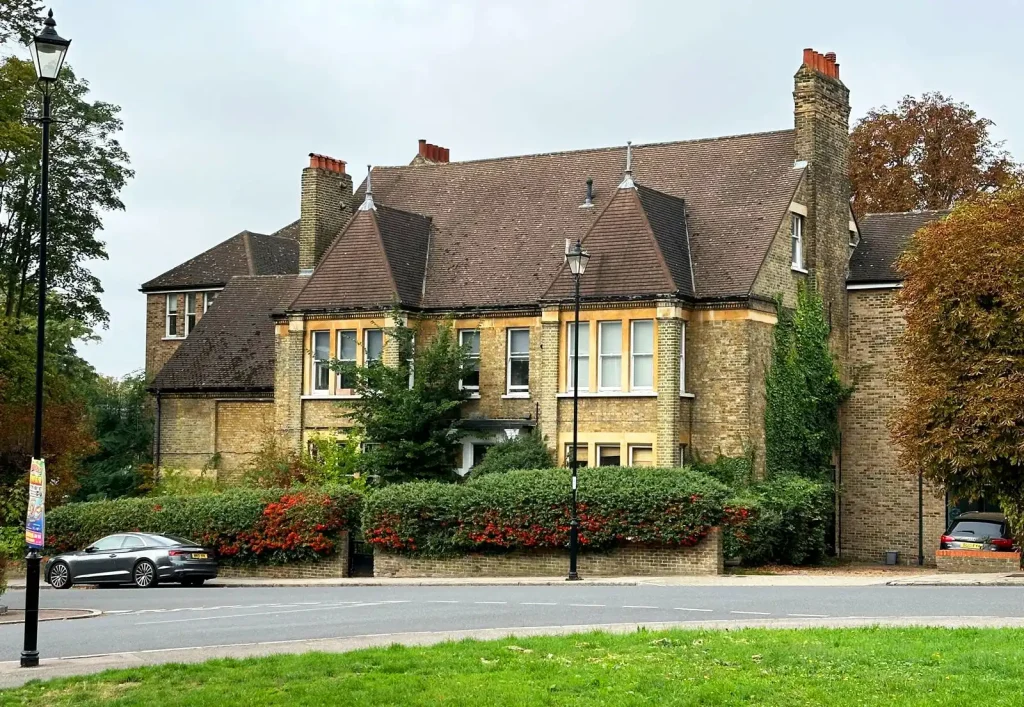
Once the Brockley house was ready, Lusia brought my mother to London to join her. My mother became housekeeper while Lusia continued as the children’s nanny. The two sisters shared a small attic room (shown in the right elevation of the associated photo) with a sloping roof on the top floor of 21 Adelaide Avenue.
Photo credit: Kazimierz Ślęczka.
Lusia remained in England until returning to Poland before 1950. In 1980, my mother and Kazimierz returned together to 21 Adelaide Avenue, where the new owners kindly welcomed them inside and showed them up to the top-floor attic room where both sisters had lived together over thirty years earlier.
Harvey C. Bishop ARIBA and the Sunderland Connection
Mr Harvey C. Bishop ARIBA, who employed Aniela in Brockley both before and after her time at Princes Gate, was a qualified associate of the Royal Institute of British Architects. He later took on a prominent civic role as Borough Architect for Sunderland, overseeing significant municipal post-war housing and public building projects during a period of major urban regeneration, a legacy that heritage bodies still study today. Source: Researching Sunderland’s Heritage Action Zone.
Aniela’s return to his household in Sunderland during the early 1960s highlights the enduring mutual respect and trust between employer and employee.
Andrzej (author of this post) and the Sunderland/Yorkshire Connection
Many years later, that short stay in Sunderland took on an unusual character: during the inquiry into the notorious “Wearside Jack” hoax cassettes (the Jack the Ripper hunt), the police systematically interviewed men throughout the country who had spent time in Sunderland and had recently been to Yorkshire. My attendance at infants school in Sunderland produced a database match, which led me to attend a voluntary interview at Mitcham Police Station in Surrey, where an officer took my fingerprints, checked my accent and handwriting, confirmed it was obviously a false lead, and said he would recommend to his superiors that the file be closed.
Conclusion
The main account, however, is still preserved in those yellowed pages: a young Polish woman showing strength as she lived in post-war London, won the respect of her employers, and gradually took on more responsibility when history came to dinner.
This post is featured on South Coast View’s Substack publication: When My Mother Cooked for JFK.
Enjoy reading my commentary? Add South Coast View as a Preferred Source on Google to see new posts first.

Subscribe to future posts on South Coast View by email. No spam, just a notification when a new article is published.
Having trouble confirming? Read my subscription guide.
 Follow on Substack
See my explainer titled “What is Substack“.
A selection of featured posts. View all posts.
The 1601 Józefowo Inheritance: Rodziewicz Family History & Roots
Harvey C. Bishop: The Modernist Visionary Who Reshaped Sunderland’s Skyline

Ukraine UAV Fundraiser: Urgent Appeal