- Introduction to The Coats of Arms of the Rodziewicz Family
- How Polish Coats of Arms (Herby) Differ from British Coats of Arms
- A Note on the Illustrations
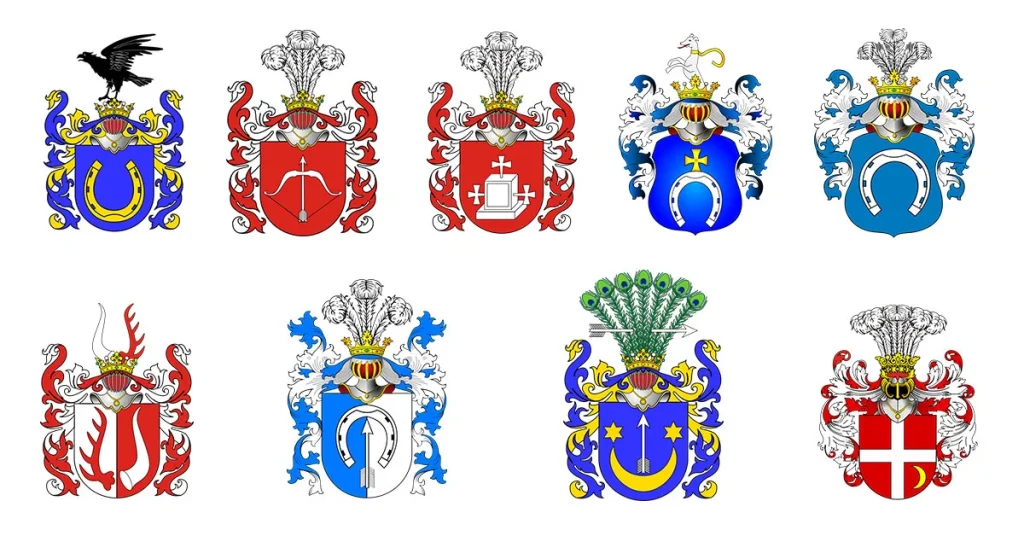
- At a Glance: The Nine Coats of Arms of the Rodziewicz Family
- Illustrations, Blazons Descriptions and Historical Contexts
- Primary Sources & Image Credits: Historical & Genealogical References
Introduction to The Coats of Arms of the Rodziewicz Family
In my 1601 Józefowo Inheritance: Rodziewicz Family History & Roots, I traced the Vitebsk and Volhynia branch of the family, a line bearing the Łuk coat of arms, using surviving court and nobility records. While researching any Polish noble line, you may ask: why do historical armorials link each surname to many different coats of arms?
How Polish Coats of Arms (Herby) Differ from British Coats of Arms
Readers used to British heraldry will almost certainly assume a coat of arms belongs to a single person and passes only to the direct line of descent. In the Polish–Lithuanian Commonwealth it was quite different. A Polish coat of arms (herb) belonged to a much wider heraldic clan (ród herbowy), to which dozens, sometimes hundreds, of unrelated families belonged.
On the other hand, a single surname does not imply common descent. The Rodziewicz families in Samogitia, Vitebsk, Volhynia, and Galicia in the Polish-Lithuanian Commonwealth who took that surname often came from completely separate lines, each with its own distinct coat of arms. That is why commercial websites that sell a single ‘Rodziewicz family crest’ are quite misleading. Researchers must consult the archives to determine which branch of the family is associated with which region.
The Rodziewicz Family Association website (Stowarzyszenie Rodu Rodziewiczów) has an historical overview of the herby szlacheckie (coats of arms) of the Rodziewicz family, which can be found on the Wayback Machine archive of rodziewicz.waw.pl. The catalogue of herby szlacheckie borne by the Rodziewicz family in the former Polish-Lithuanian Commonwealth lists nine distinct herby: Jastrzębiec, Łuk, Mogiła, Pobóg, Podkowa, Rogala, Rudnica, Sas, and Tarnawa. You can find an alphabetical guide below to each of the herby with a summary of the historical context.
A Note on the Illustrations
of the Coats of Arms of the Rodziewicz Family
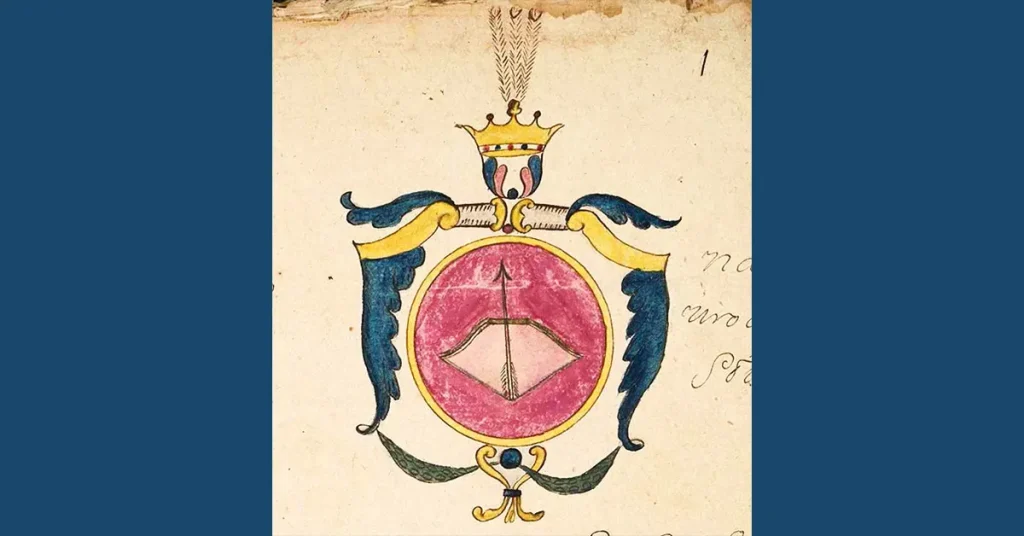
The coats of arms in this guide are contemporary vector graphics, principally drawn from Tadeusz Gajl’s Polish Armorial (Herbarz Polski) and available on Wikimedia Commons under Creative Commons licences. They are modern, standardised reconstructions designed for clarity, not scans of original documents. To see how an actual 19th-century drawing would have looked compared to the modern graphic, see the verified manuscript version of Herb Łuk in The 1601 Józefowo Inheritance: Rodziewicz Family History & Roots on this website.
At a Glance: The Nine Coats of Arms of the Rodziewicz Family
| Coat of Arms | Alternative Name(s) | Main Shield Motif | Recorded Regions & Key Sources |
|---|---|---|---|
| Jastrzębiec | Boleścic, Łazęka | Blue field; gold horseshoe open upwards enclosing a gold cross pattée | Widespread across Poland and the Grand Duchy of Lithuania; Gajl (Herbarz polski) |
| Łuk | Łuk Napięty | Red field; drawn silver bow with an arrow pointing upwards | Vitebsk and Volhynia branches; 1601 Józefowo records, Niesiecki, Kojałowicz, Gajl |
| Mogiła | Mogiła I | Red field; silver burial mound with three silver crosses pattée | Samogitia and Grand Duchy of Lithuania; Niesiecki, Kojałowicz, Gajl |
| Pobóg | Pobog, Pobodze | Blue field; silver horseshoe arch-upwards topped with a gold cross pattée | Poland and Grand Duchy of Lithuania (Horodło, 1413); Gajl |
| Podkowa | None | Blue field; single silver horseshoe (no cross) | Galicia (1841), Kovno Governorate (1864); Ostrowski, Gajl |
| Rogala | Czabory | Divided silver and red shield; red stag antler (left) and white buffalo horn (right) | Mazovia, Greater Poland, and Grand Duchy of Lithuania; Gajl |
| Rudnica | Następ | Divided blue and silver shield; silver horseshoe arch-upwards enclosing an upward arrow | Vitebsk Governorate and Samogitia; Niesiecki (Vol. 8), Herbarz szlachty prowincyi witebskiej (1899), Gajl |
| Sas | Drag | Blue field; gold crescent horns-upwards with two gold stars and an upward silver arrow | Red Ruthenia, Galicia, and eastern borderlands; Gajl |
| Tarnawa | None | Red field; silver Greek cross accompanied by a gold crescent beneath the lower-right arm | Lesser Poland and Samogitia; Niesiecki, Gajl |
Illustrations, Blazons Descriptions and Historical Contexts
of the Nine Coats of Arms of the Rodziewicz Family
Coat of Arms Jastrzębiec
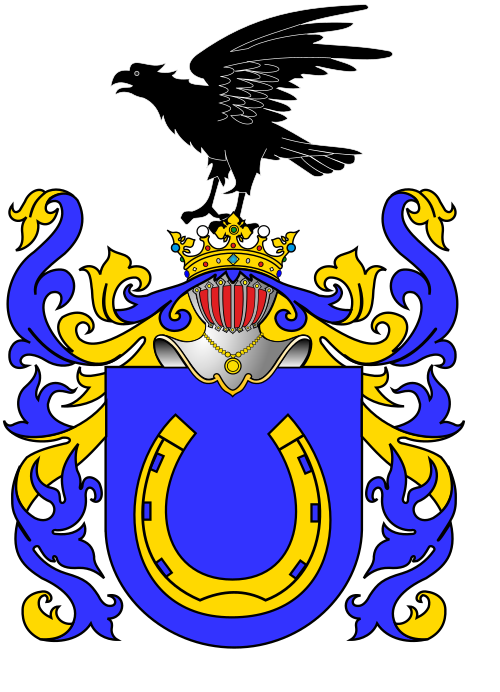
Blazon: A blue shield, a gold horseshoe open upwards, enclosing a gold cross pattée (krzyż kawalerski). Above the helmet and noble crown is a hawk (jastrząb) with a gold horseshoe and cross in its talons.
Historical context: Jastrzębiec is one of the oldest and most widespread coats of arms in Polish heraldry, appearing on seals as early as the 14th century and being extended to the Lithuanian boyar families (the native landowning warrior nobility of the Grand Duchy of Lithuania) at the Union of Horodło in 1413. Tadeusz Gajl’s surname index includes Rodziewicz as one of the families bearing the Jastrzębiec coat of arms, with some of the associated historical notes held by the Rodziewicz Family Association.
Coat of Arms Łuk (Łuk Napięty)
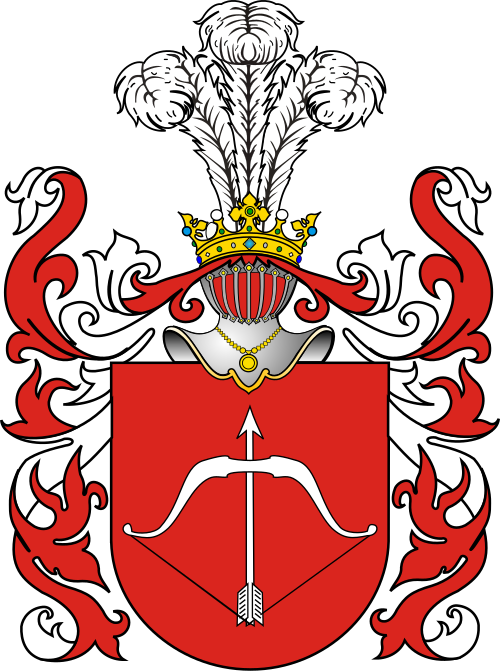
Blazon: On a red shield a drawn silver bow (łuk napięty) with an arrow notched and pointing straight upwards. Crest: Three ostrich feathers above a noble crown, with red mantling lined in silver.
Historical context: Łuk is the coat of arms for the Vitebsk and Volhynia line of the Rodziewicz family. It’s in Niesiecki’s Herbarz polski and in Wijuk Kojałowicz’s Lithuanian armorial and it’s in the 19th century Volhynia nobility claim dossier (DAZhO 146-1-5039) which was looked at in The 1601 Józefowo Inheritance. Gajl’s modern rendering is a very clean red and silver, the original drawings from the Russian Empire period are a bit more varied in terms of the proportions of the shield and the detail.
Coat of Arms Mogiła
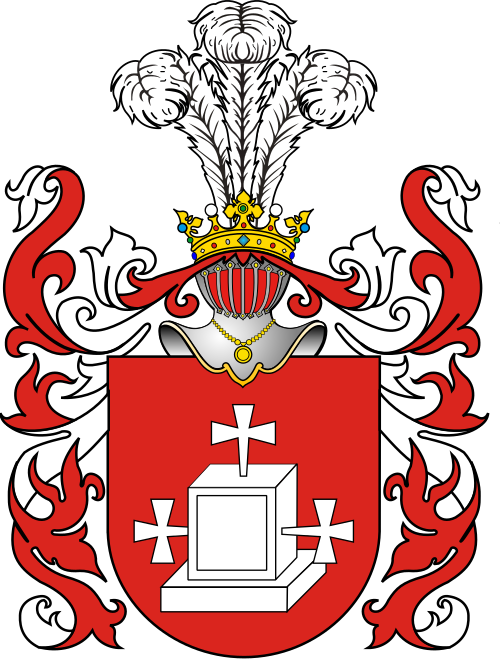
Blazon: On a red shield, a silver burial mound (mogiła) on a cross. Three ostrich feathers on the helmet and noble crown.
Historical context: Mogiła is strongly tied to the Grand Duchy of Lithuania, particularly Samogitia (modern western Lithuania), where it was borne by prominent local families such as the Bilewicz and Stankiewicz lines. Polish heraldic indexes, including Gajl’s Herbarz polski, list Samogitian Rodziewicz branches among the bearers of Mogiła.
Coat of Arms Pobóg
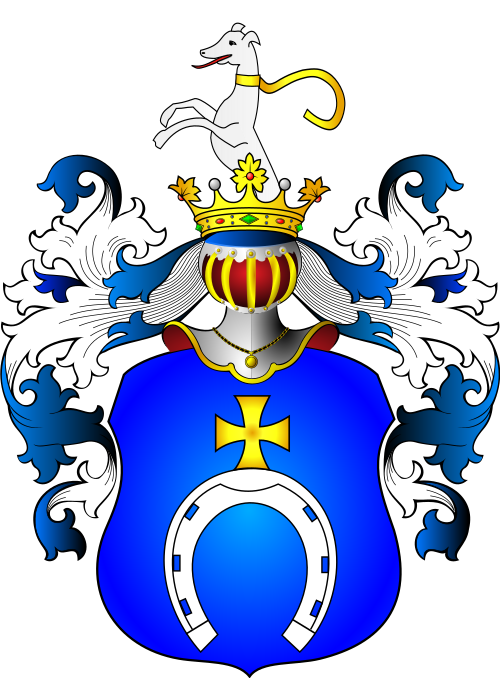
Blazon: On a blue shield, a silver horseshoe, arching upwards, crowned with a gold cross pattée. Crest: The upper half of a silver greyhound (chart), facing (viewer’s left).
Historical context: Pobóg is as old as Jastrzębiec (first recorded in the 14th century) and was one of the coats of arms adopted by the Lithuanian magnates at the Union of Horodło in 1413. It’s in Tadeusz Gajl’s register for the Rodziewicz surname, representing the various branches of the family that settled in the Crown and the Grand Duchy of Lithuania.
Coat of Arms Podkowa
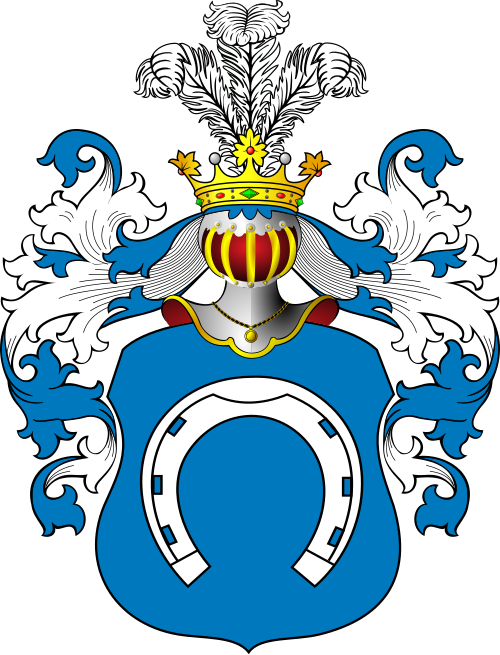
Blazon: On a blue shield, a single silver horseshoe (podkowa) without a cross or arrow. Above the helmet and noble crown sit three ostrich feathers, with blue mantling lined in silver.
Historical context: First recorded in the first half of the 18th century as the arms of the Polish–Lithuanian Tatar noble family Rudnicki (including General Czymbaj Murza Rudnicki), Podkowa later appeared on 19th-century nobility confirmation diplomas in Galicia (1841) and Kovno Governorate (1864) and was catalogued by Juliusz Ostrowski in Księga herbowa rodów polskich. Although Tadeusz Gajl lists the Rodziewicz surname under Podkowa (see also Polish Wikipedia: Podkowa), Włodzimierz Rodziewicz’s archived Association page provides no further genealogical notes for this branch, and linking a specific family line to Podkowa requires independent archival proof.
Coat of Arms Rogala
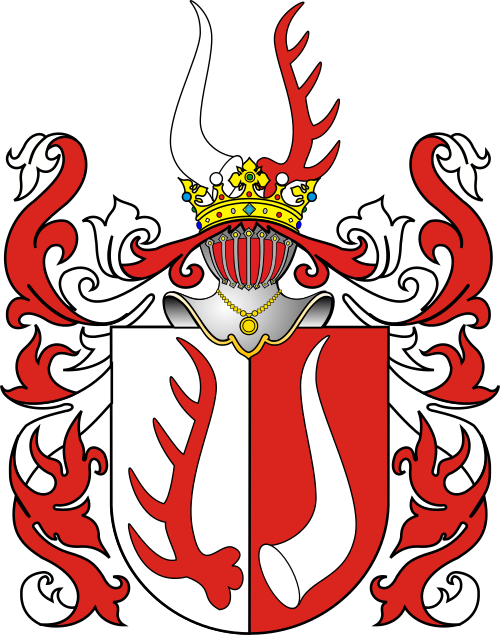
Blazon: A vertically divided shield: on the heraldic right (viewer’s left), a red stag antler on a white (silver) field; on the heraldic left (viewer’s right), a white buffalo horn on a red field. The crest repeats the white buffalo horn and red stag antler above a noble crown, with red-and-silver mantling.
Historical context: Rogala is an ancient medieval Polish coat of arms (earliest known seal from the 14th century), originally rooted in Mazovia and Greater Poland before spreading eastward into the Grand Duchy of Lithuania. It is recorded for branches of the Rodziewicz family in Tadeusz Gajl’s Herbarz polski and listed in the archived Rodziewicz Family Association overview.
Coat of Arms Rudnica (Następ)
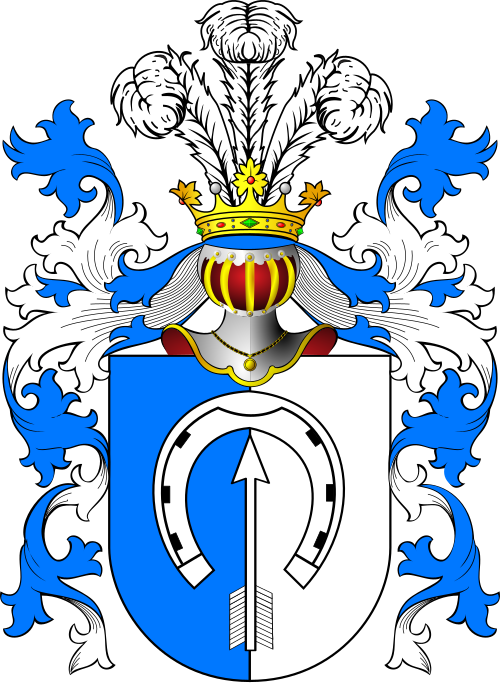
Blazon: A vertically divided shield, blue on the heraldic right (viewer’s left) and silver on the heraldic left, featuring a silver horseshoe facing arch-upwards and enclosing a silver arrow pointing straight up toward the arch. The crest displays three ostrich feathers above a noble crown, with blue mantling lined in silver. (Older armorials occasionally note slight regional colour variations.)
Historical context: Listed in Kasper Niesiecki’s Herbarz polski (Vol. 8, pp. 173-174; indexed on Wielcy.pl) under the dual name of Rudnica albo Nastep, this coat of arms has a clear historical link to the Vitebsk region. The 1899 Herbarz szlachty prowincyi witebskiej (available online via the transcriptions of Lyczkowski’s Vitebsk Province Gentry Armorial) records the Rodziewiczowie herbu Rudnica in addition to the separate Vitebsk line bearing the Herb Łuk, thus demonstrating that there were indeed two distinct Rodziewicz lines in the province with different arms. More detail is available on Polish Wikipedia: Rudnica.
Coat of Arms Sas
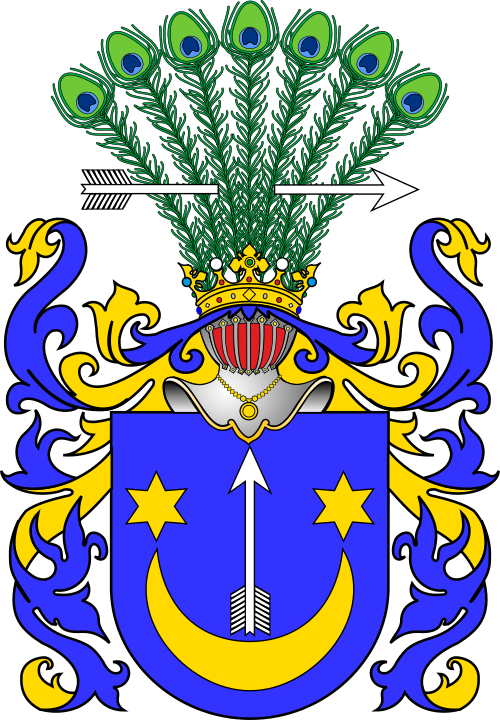
Blazon: A blue shield bearing a golden crescent, with a six-pointed star of gold above each horn and a silver arrow pointing upward from the centre. Crest: A fan of peacock feathers, pierced horizontally by a silver arrow, with blue mantling edged with gold.
Historical context: Sas (also known historically as Drag) originated in the 14th century among Ruthenian and Wallachian-descended knightly families who settled in Red Ruthenia and the Carpathian foothills (later eastern Galicia). Today it is one of the most recognisable coats of arms of south-eastern Poland and western Ukraine. Tadeusz Gajl’s Herbarz polski includes Rodziewicz among the surnames associated with Sas.
Coat of Arms Tarnawa
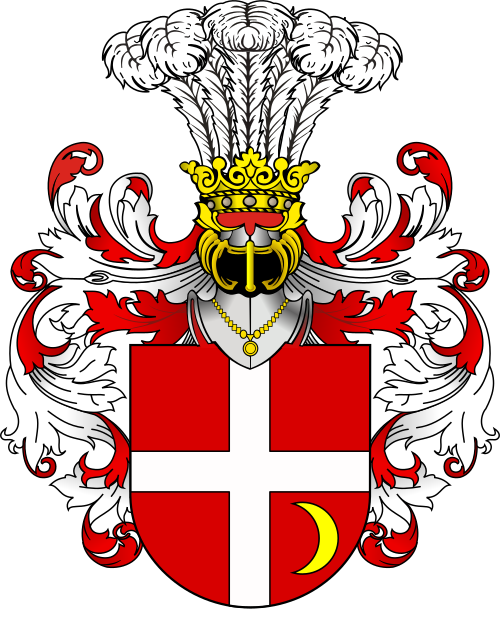
Blazon: On a red shield, a silver cross pattée accompanied in the lower-right corner (heraldic left) by a gold crescent facing outwards. The crest displays five ostrich feathers above a noble crown, with red mantling lined in silver.
Historical context: First recorded in the 14th century in Lesser Poland, Tarnawa spread into the Grand Duchy of Lithuania (including Samogitia), where Rodziewicz families bearing the Tarnawa coat of arm are found in addition to those with Mogiła and Rudnica. It is listed in Gajl’s Herbarz polski for the Rodziewicz surname and is referenced on the archived Rodziewicz Family Association page.
A note for family historians: if you find the surname Rodziewicz listed under a coat of arms in Tadeusz Gajl’s Herbarz polski, Kasper Niesiecki’s armorial or in an online surname index that only tells you that at least one branch of the Rodziewicz family did use those arms. It doesn’t prove that your own ancestors used those arms. To prove a heraldic link you need to go back generation by generation to the parish registers, land court deeds and the 19th century guberniya nobility confirmation files (heroldia dossiers).
Primary Sources & Image Credits: Historical & Genealogical References
- Rodziewicz Family Association (Stowarzyszenie Rodu Rodziewiczów), archived historical overview: rodziewicz.waw.pl via Wayback Machine (8 July 2018 capture)
- Tadeusz Gajl, Herbarz polski: od średniowiecza do XX wieku (Gdańsk, 2007) — surname index hosted on Ornatowski.com (Letter R)
- Kasper Niesiecki, Herbarz polski (Leipzig, 1839–1846) — digital index at Wielcy.pl
- Herbarz szlachty prowincyi witebskiej (Kraków, 1899) — English-language transcription at Lyczkowski.net
- Companion study: The 1601 Józefowo Inheritance: Rodziewicz Family History & Roots
Image Credits (Wikimedia Commons): Coats of Arms of the Rodziewicz Family
All nine coats of arms are contemporary vector renderings sourced from Wikimedia Commons. Clicking any filename opens the source file and full revision history.
- Herb Jastrzębiec: File:POL COA Jastrzębiec I.svg — Design by Tadeusz Gajl (Herbarz polski, 2007); vectorised by Bastian and arranged by Avalokitesvara. Licensed under CC BY-SA 3.0 Unported (Wikimedia VRTS
#2010103110006684). - Herb Łuk: File:POL COA Łuk.svg — Design by Tadeusz Gajl (Herbarz polski, 2007); vector base by Bastianow; charges and arrangement by Avalokitesvara. Licensed under CC BY-SA 3.0 Unported (Wikimedia VRTS
#2010103110006684). - Herb Mogiła: File:POL COA Mogiła.svg — Design by Tadeusz Gajl; vector base by Bastianow; charges and arrangement by Avalokitesvara. Licensed under CC BY-SA 3.0 Unported.
- Herb Pobóg: File:POL COA Pobog.svg — Created by Voytek S, based on a template by Bastianow after Tadeusz Gajl. Licensed under CC BY-SA 2.5 Generic.
- Herb Podkowa: File:POL COA Podkowa.svg — Vectorised by Bastianow (Bastian), based on Juliusz Ostrowski, Księga herbowa rodów polskich, Vols. 1–2 (Warsaw, 1897). Licensed under CC BY 3.0 Unported.
- Herb Rogala: File:POL COA Rogala.svg — Exterior by Bastianow after Tadeusz Gajl; shield interior by WarX (later updated by Avalokitesvara). Licensed under CC BY-SA 2.5 Generic.
- Herb Rudnica: File:POL COA Rudnica.svg — Vectorised by Bastianow (Bastian), based on Juliusz Ostrowski, Księga herbowa rodów polskich (Warsaw, 1897). Licensed under CC BY 3.0 Unported.
- Herb Sas: File:POL COA Sas I.svg — Design by Tadeusz Gajl (Herbarz polski, 2007); vector base by Bastianow; peacock feathers by WarX; charges and arrangement by Avalokitesvara. Licensed under CC BY-SA 3.0 Unported (Wikimedia VRTS
#2010103110006684). - Herb Tarnawa: File:POL COA Tarnawa.svg — Design by Tadeusz Gajl (Herbarz polski, 2007); vectorised by Macbulwa (incorporating elements by Bastian, WarX, Melian, and Magnus_Manske). Licensed under CC BY-SA 3.0 Unported (Wikimedia VRTS
#2010103110006684).
Enjoy reading my commentary? Add South Coast View as a Preferred Source on Google to see new posts first.

Subscribe to future posts on South Coast View by email. No spam, just a notification when a new article is published.
Having trouble confirming? Read my subscription guide.
 Follow on Substack
See my explainer titled “What is Substack“.
Posts tagged with Poland. See all in Poland.
The 1601 Józefowo Inheritance: Rodziewicz Family History & Roots
Working at The German Post Office in Kraków During WWII
August Browne: The True Story