- About This Post
- How The Rebuilding of Warsaw Was Aided After The Second World War
- Views of Castle Square in 1945 and After its Reconstruction
- Bernardo Bellotto as Court Painter to The King of Poland
- The Use of Bellotto’s Paintings Aided the Rebuilding of Warsaw.
- The Complete Collection of Bellotto's Vedute at the Royal Castle in Warsaw
- It is not easy to view all of Bellotto's vedute of Warsaw on one page
- The bodies responsible for the rebuilding of Warsaw and the Royal Castle
- Phase II: The Publicly-Funded Castle Restoration (The OKOZK)
- Citizen Involvement in the Rebuilding of Warsaw
- Key Aspects of the National Effort to Rebuild Warsaw
- Recommended videos about the rebuilding of Warsaw
- The Destruction of Warsaw was Near Total
- Dresden – Another City Rebuilt From Bellotto's Vedute
- A Selection of Bellotto's Vedute of Dresden
- Frequently Asked Questions on Bellotto's Blueprints and Warsaw's Rebirth
- South Coast View is on Substack
About This Post
This post covers the work of the Italian painter Bernardo Bellotto, whose vedute of Warsaw were crucial to the rebuilding of Warsaw after World War II.
How The Rebuilding of Warsaw Was Aided After The Second World War
When German forces systematically destroyed Warsaw’s Old Town, very few original building plans or photographs survived.
The safeguarded Bellotto paintings provided essential visual references for reconstructing Warsaw’s Old Town and Royal Castle as they appeared during the city’s 18th-century “golden age.”
This painting is titled “Krakowskie Przedmieście od kolumny Zygmunta” in Polish. The view is oriented slightly east of south.

Bellotto’s painting above shows Castle Square and the Royal Castle in Warsaw, which is visible to the left of the Zygmunt Column. The Aleksander John Tenement building is seen to the right. The painting shown here is located in the Canaletto Room at the Royal Castle in Warsaw.
Views of Castle Square in 1945 and After its Reconstruction


The Zigmunt III Column is in the centre, and the Aleksander John Tenement building is to its right.
The first photograph above (public domain) was taken in 1945. Attribution of the second photograph above is: Maksym Kozlenko, CC BY-SA 4.0 via Wikimedia Commons.
The direction in which the 1945 photograph was taken is unclear. The contemporary view of Castle Square, facing Krakowskie Przedmieście, resembles the viewpoint of Bellotto’s painting.
Bernardo Bellotto as Court Painter to The King of Poland
In the 18th century, the Italian painter Bernardo Bellotto (who called himself Canaletto after his famous uncle) was commissioned as court painter to the last king of Poland, Stanisław August Poniatowski.
Bellotto painted over 20 detailed panoramic views of Warsaw, known as vedute—highly detailed, large-scale paintings of Warsaw’s vistas.
The Use of Bellotto’s Paintings Aided the Rebuilding of Warsaw.
Bellotto’s painting titled “View of Warsaw from the Terrace of the Royal Castle” is considered the finest vedute of the Enlightenment-era Warsaw, celebrated for its wide perspective, precise architectural depiction, and artistic composition. By balancing the city’s buildings, the surrounding landscape, and the elegant, small figures of people, Bellotto creates a harmonious visual experience.
All of Bellotto’s vedute, such as those shown here, guided the reconstruction of Warsaw’s destroyed buildings.
Adapted from: Google Arts & Culture.

In Polish, this painting is known as “Widok Warszawy z tarasu Zamku Królewskiego” (View of Warsaw from the terrace of the Royal Castle), and it is located at the National Museum in Warsaw.
Bernardo Bellotto’s paintings of Warsaw, as mentioned, were a crucial resource in rebuilding the city’s historic centre after its destruction during World War II.
Bellotto was known for his almost photographic precision, which he achieved by using a camera obscura (a precursor to the camera). This level of detail made his paintings an invaluable architectural blueprint for the rebuilding of Warsaw.
The most complete collection of Bernardo Bellotto’s Vedute of Warsaw is held by the Royal Castle in Warsaw (Zamek Królewski w Warszawie), where they are displayed in the famous “Canaletto Room.” Source: Royal Castle in Warsaw. Note: The source page may display in Polish. To view the English version, navigate to Menu and choose EN from the left-hand side navigation.
The Complete Collection of Bellotto’s Vedute at the Royal Castle in Warsaw
Photo Gallery of Bellotto’s Vedute.
Click or tap any image below (above the captions) to view the full-sized painting.


It is not easy to view all of Bellotto’s vedute of Warsaw on one page
In the gallery above, all vedute are displayed together for easy viewing. The Royal Castle in Warsaw assigns copyright to all vedute on its website. Images here come from Wikimedia, and are in the public domain.
The bodies responsible for the rebuilding of Warsaw and the Royal Castle
Phase I: The Immediate State-Led Reconstruction (The BOS)
The state-owned body Biuro Odbudowy Stolicy (BOS) (Warsaw Reconstruction Office) was responsible for the rebuilding of Warsaw. The BOS was officially active from 1945 to 1951.
Phase II: The Publicly-Funded Castle Restoration (The OKOZK)
The Castle’s rebuilding was initially postponed for political reasons (it was seen as a symbol of the monarchy). Its reconstruction was eventually undertaken decades later, primarily through the Civil Committee for the Reconstruction of the Royal Castle (OKOZK) (Obywatelski Komitet Odbudowy Zamku Królewskiego w Warszawie) with massive social fundraising, starting in 1971. The Royal Castle in Warsaw was reopened to the public in 1984.
Citizen Involvement in the Rebuilding of Warsaw
The citizens of Warsaw played an essential and heroic role in the aftermath of World War II by undertaking massive, voluntary efforts to clear the city’s vast rubble and salvage materials.
Although construction workers and specialised builders completed most of the work, local residents were needed to clear large amounts of debris. “The entire nation builds its capital” became the city’s rallying cry. Source: How postwar Warsaw was rebuilt using 18th-century paintings. The Guardian Newspaper.
Key Aspects of the National Effort to Rebuild Warsaw
- Rubble Clearing: Citizens organised themselves into brigades to clear mountains of rubble from streets and squares, a backbreaking and often dangerous task.
- Brick Sorting and Cleaning: The most crucial early effort was salvaging building materials. Tens of thousands of people manually cleaned old bricks, one by one, to be reused in new construction. This resourcefulness was vital, as new materials were scarce and expensive.
- Rebuilding Spirit: This voluntary labour, often referred to as the “National Effort” or the “social reconstruction movement,” fostered a powerful sense of collective responsibility and national pride. The determination of the people to rebuild their capital—literally from the ground up—was a core characteristic of post-war Warsaw.
Recommended videos about the rebuilding of Warsaw
Video subject: The Rebuilding of Warsaw after World War Two.
Video subject: The Rebuilding of Warsaw.
The first video above (published in 2025) focuses on the crucial and pioneering work of the renowned Polish architect Zbigniew Krawczyński, who worked for the Warsaw Reconstruction Office (BOS). The second video above (published in 1950) is an official Polish Government publication that depicts the state and citizen participation in the rebuilding of Warsaw.
The Destruction of Warsaw was Near Total
Over 85% of the historic centre was deliberately razed after the 1944 Warsaw Uprising, and this further highlights the heroism of the Polish architects and the magnitude of the task.


The first photograph above is dated 1946-1949, and it appears that initial rebuilding works may have commenced. The second photograph, from 1972, shows the restored Zygmunt III column with an empty space to the right, where the Royal Castle would stand after restoration.
Dresden – Another City Rebuilt From Bellotto’s Vedute
Bellotto lived and worked in Dresden as the court painter for the Elector of Saxony and King of Poland, Augustus III, from 1747 to 1758, producing numerous highly detailed paintings of Dresden and its nearby town, Pirna.
Allied bombings during World War II almost completely levelled Dresden, causing its historic centre to be practically destroyed.
A Selection of Bellotto’s Vedute of Dresden
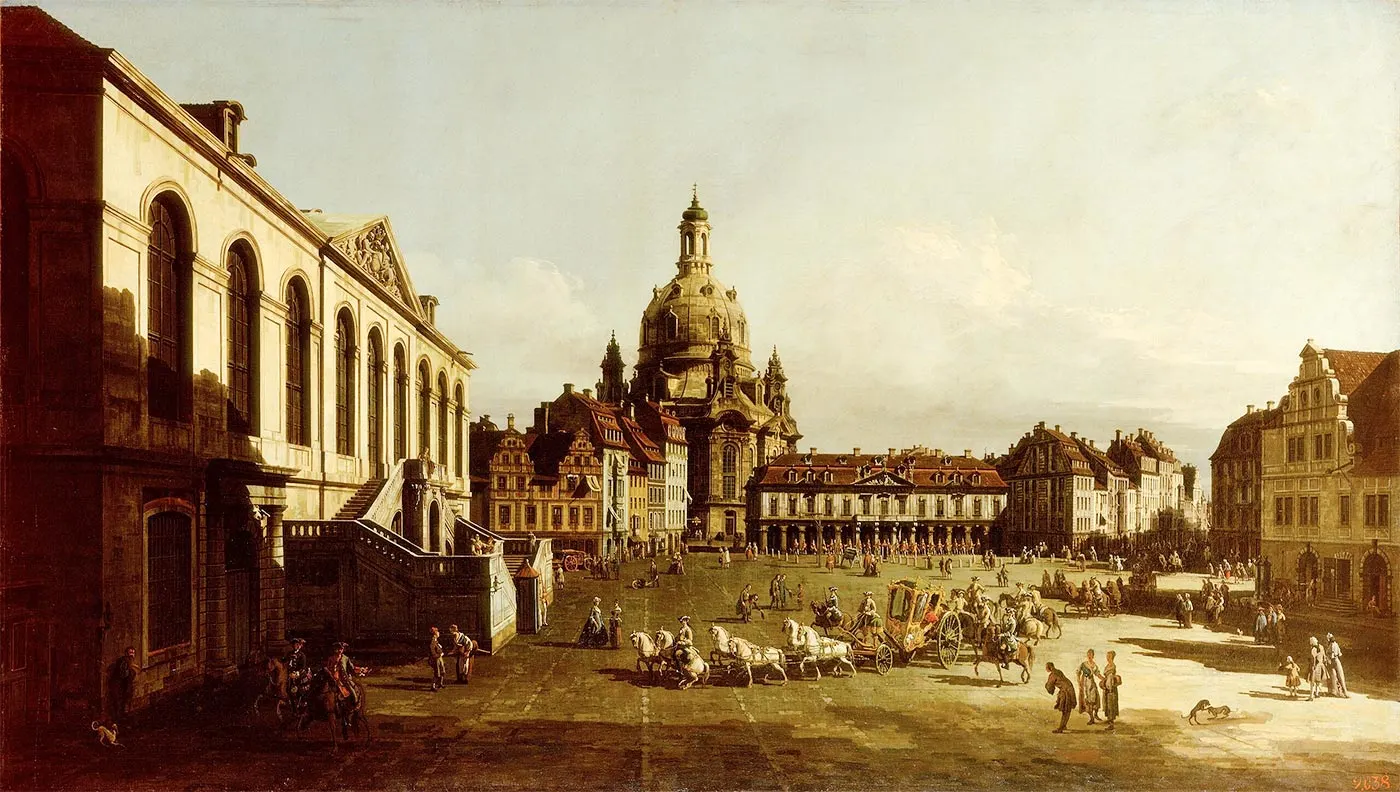
The Neumarkt in Dresden


Bellotto’s approximately 29 views of Dresden were renowned for their topographical meticulousness, perspective, and detail. These paintings became an essential reference for architects and preservationists in the German Democratic Republic (GDR).
Frequently Asked Questions on Bellotto’s Blueprints and Warsaw’s Rebirth
Your Comments are Welcome
If you have visited Warsaw’s historic centre or the Royal Castle, please share your comments below.

Subscribe to future posts by email. No spam, just an email when a new post is published. View the posts.
Articles tagged with Poland. See all in Poland.

The Girls of Handlówka in Cieszyn: Class III.B of 1936
Battle of Racławice Panorama in Wrocław
Wrocław Old Town – Beautiful in Summer 2025