

Introduction
The German occupation of Kraków produced an enormous volume of paperwork: forms, petitions, employment questionnaires, and letters that passed between firms and the offices responsible for the expulsion of Jews from the city. Most of these documents were created to regulate, restrict, or remove. Yet within them, individual names appear, sometimes faintly, sometimes clearly, revealing the people who administered this system at the level of everyday decisions.
The Treuhänder System
After the German occupation of Poland, Jewish‑owned and non-Jewish businesses were seized and placed under the control of appointed trustees known as Treuhänder. These administrators were responsible for:
- managing the firm’s operations
- reporting to German authorities
- determining which Jewish employees were “indispensable”
- communicating with the offices responsible for Jewish expulsions
Treuhänder were not owners; they were state‑appointed managers whose authority rested on the occupation administration. Their decisions could affect whether a Jewish employee remained in Kraków (or in other areas of Poland) or was expelled.
In Kraków, the Aryanisation of Jewish businesses began early and proceeded rapidly, with many firms placed under Treuhänder control by late 1939 and early 1940.
Many Treuhänder in the General Government were Austrians, reflecting both administrative recruitment patterns and the integration of Austrian personnel into occupation structures after 1938.
Treuhänder Leopold Amersin
One such figure is Leopold Amersin, the Treuhänder (trustee) appointed to run the Aryanised firm A. Nussbaum in Kraków. His name appears repeatedly in the documents relating to the Englard family, including those used in the reconstruction of Mala Englard’s story, published earlier on this site. This post brings together what can be said about Amersin based solely on surviving archival evidence.
Amersin’s Role in Kraków
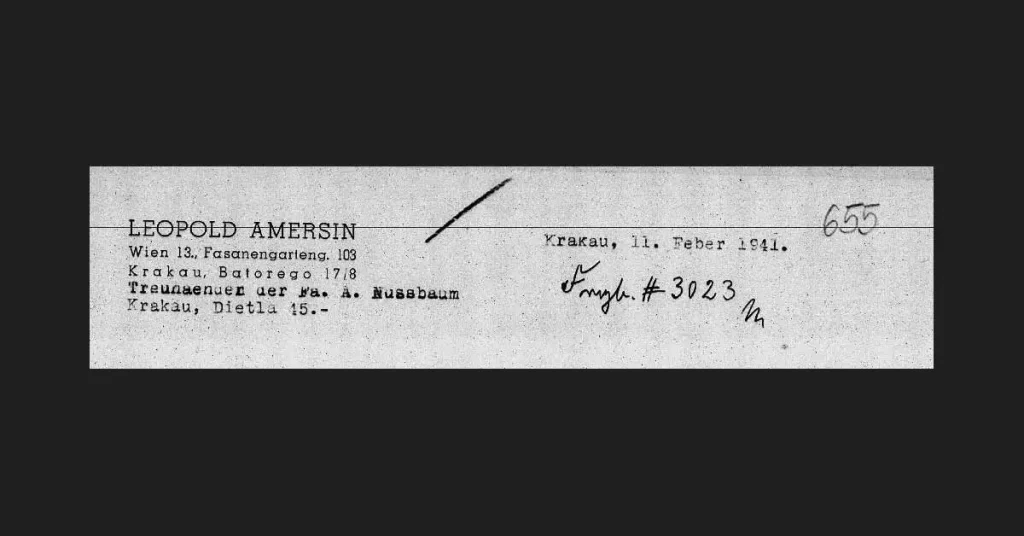
Amersin’s name appears most clearly in a letter dated 11 February 1941, written on an A. Nussbaum letterhead and addressed to the Department of Jewish Resettlement in Kraków. The letter requests the postponement of the expulsion of a Jewish employee, Perla Steinhof, because she was needed for correspondence and bookkeeping while the firm completed its annual balance sheet for 1940.

Source: USHMM. Stable link.
The letter is signed:
Leopold Amersin
Treuhänder der Firma A. Nussbaum
His addresses appear as:
- Vienna 13., Fasanengarten 103
- Kraków, Batorego 17/8
- Kraków, Dietla 45
This confirms that on the date this letter was created, Amersin administered the firm of A. Nussbaum from Vienna and Kraków.
Interventions on Behalf of Jewish Employees
Amersin’s signature also appears on documents relating to Mala Englard and her family. These include:
- employment questionnaires
- declarations of indispensability
- requests for postponement of expulsions
In Mala’s case, Amersin argued that she was needed for clerical and accounting work. Similar arguments were made for her father and sister, neither of whom were employed at A. Nussbaum. These interventions did not remove the family from danger, but they may have delayed their expulsion from Kraków.
The documents read like a corporate audit, obsessed with ‘labour needs’ and ‘deadlines’ instead of human beings. But that red tape was exactly what worked. It used the office’s boring language to perform a miracle: it sometimes kept people in the city for just a little longer.
What the Documents Do Not Reveal
The surviving material does not allow us to determine:
- Amersin’s personal motives
- whether he acted out of pragmatism, habit, or inclination
- whether he was more lenient or more severe than other Treuhänder
- his political affiliations beyond his administrative role
Online claims that he was a member of the Austrian SS cannot be confirmed from the only document currently available. The references in secondary sources lack dates, addresses, or corroborating details and therefore cannot be definitively linked to the same individual. Without primary evidence, such as personnel files or archival records , such claims must remain unverified. Source: Die Anfänge der Wiener SS. 2012. The beginnings of the Vienna SS.
A Bureaucrat in the “Grey Zone”
Amersin’s actions show the ambiguous space occupied by mid‑level administrators in the occupation bureaucracy. His interventions were framed in the language of necessity and efficiency, not compassion. Yet they had consequences for the people whose names appeared on his forms.
This does not make him a “good” Treuhänder, nor does it place him outside the system that dispossessed and expelled Kraków’s Jews. It simply shows that, within that system, individuals sometimes used the limited discretion available to them to temporarily alter and extend another person’s life.
Connection to the Mala Englard Story
The documents bearing Amersin’s signature form part of the archival record used to reconstruct the life of Mala Englard, whose story is told in detail here:
Tracing A Name Through Occupied Kraków – Mala Englard
Her experience shows the real-world impact of Amersin’s leadership. His decisions, however bureaucratic in tone, shaped the conditions under which she and her family may have remained longer in Kraków during the months of 1940–41.
Conclusion
Leopold Amersin appears in the historical record not as a fully rounded figure but as a name attached to decisions, signatures, and requests. Through these documents, we see the workings of the Treuhänder system at the level of individual lives. His profile, reconstructed from archival fragments, offers a small but meaningful insight into the policy in practice and the people who operated it.
I have included the memory below from my cousin Kazimierz, who grew up on the very streets mentioned in this article. While his memories don’t change the official record, they show us something that no document can: a view into the personal reality of those years. It is an indication that the official policies discussed weren’t just paperwork; they played out in everyday life, just steps away from where children played, and families went about their business under occupation.
Polish / Polski
Szara codzienność życia w okupacyjnym Krakowie wraca do mnie. O czyimś dalszym życiu lub już śmierci decydowały czasem drobne urzędnicze gesty niskiej rangi okupacyjnej administracji. Ze zdumieniem dowiaduję się, po tylu latach, co rozgrywało się tuż obok ulicy mojego okupacyjnego dzieciństwa. Nagle ożywają tamte Planty Dietla, ulica Sebastiana i maleńki sklepik Pana Laskowskiego naprzeciw naszej kamienicy. Byłem bezwiednym sąsiadem opisywanych wydarzeń.
English Translation
The grey everyday life of occupied Kraków comes back to me. Sometimes a person’s survival or death depended on small administrative gestures made by low‑ranking officials. I am astonished to learn, after so many years, what was unfolding just streets away from my childhood home. Suddenly, the Planty on Dietla, ulica Sebastiana, and Mr Laskowski’s little shop opposite our building came alive again. I was, unknowingly, a neighbour to the events you describe.
Glossary of German Terms
| Treuhänder | A trustee appointed by German occupation authorities to take control of Jewish‑owned businesses after Aryanisation. Treuhänder managed the firm’s operations, reported to German offices, and determined which Jewish employees were considered “indispensable.” They were not owners but state‑appointed administrators. |
| Arisierung | Aryanization. The forced transfer of Jewish‑owned businesses, property, and assets into non‑Jewish hands under German occupation. In Kraków, this process placed many firms under Treuhänder control. |
| Aussiedlung / Judenaussiedlung | The “Jewish Resettlement Department” within the office of the Governor General in the District of Kraków. This office processed petitions, exemptions, and postponements related to expulsions. |
| Unabkömmlich | The person responsible for running a business under the Nazi economic system. In Aryanised firms, this role was often held by the Treuhänder. |
| Betriebsführer | A German trustee in charge of a firm after its Jewish owner had been removed. |
| Generalgouvernement | General Government. The administrative region established by Germany in occupied Poland, including Kraków. It was governed separately from territories annexed directly into the Reich. |
| Aussiedlungsschein | Resettlement Certificate. A document issued by the occupation authorities ordering an individual’s expulsion from Kraków. Firms could petition for postponement if the person was deemed necessary for work. |
| Jahresbilanz | Balance Sheet. The annual financial statement of a firm. In several petitions, including those signed by Amersin, the preparation of the balance sheet was cited as a reason to delay the expulsion of Jewish employees. |
| Krankenkasse | The health insurance fund. Employment forms often asked whether a Jewish worker was registered, as part of the administrative assessment of their status. |
| Treuhänderbetrieb | A business under trustee administration. These firms continued to operate but were no longer under Jewish ownership or control. |
Comments are welcome. I would love to hear from you in the comments section below.

Subscribe to future posts by email. No spam, just an email when a new post is published. View the posts.
Articles tagged with Poland. See all in Poland.
Tracing A Name Through Occupied Kraków – Mala Englard
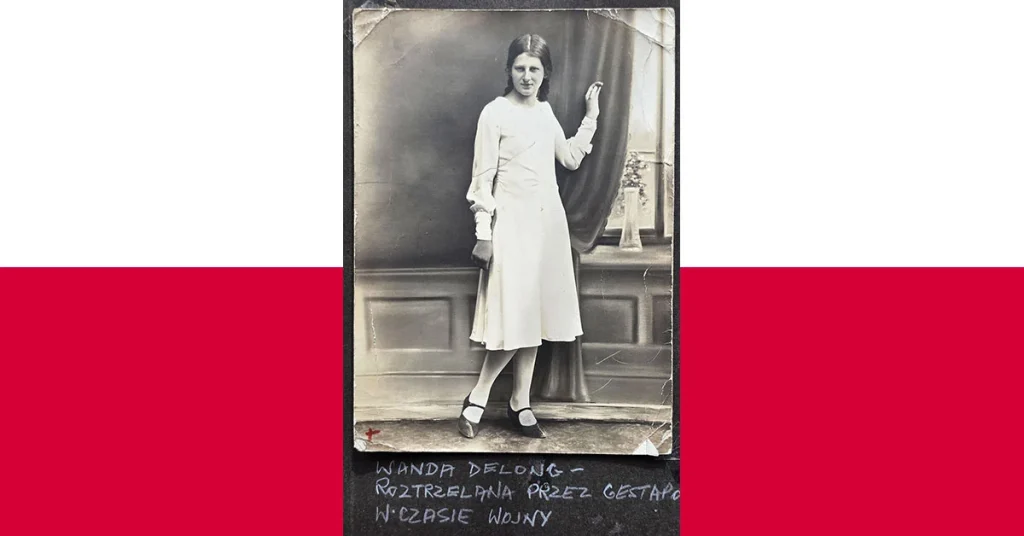
Wanda Delong | Resistance Fighter From Cieszyn

Salomea Berlińska | From a Cieszyn Schoolroom to the Kraków Ghetto?
