

- PART I – 1. A name in the margin: Englard
- 2. Mala Englard steps out of the archive
- Treuhänder Leopold Amersin
- 3. February 1941: the crisis point
- 4. March 1941: the reversal
- 5. A single firm, before and after Aryanisation
- From a Kraków Jewish Business to a Treuhänder
- 6. The question of identity
- 7. What these fragments reveal
- A note on a memorial list and Mala Englard's shool education
- Mala Englard's school education in Kielce
- PART II – Timeline: The Englard / Nussbaum Trail (1941–1942)
- Documents Consulted
- Glossary of German terms used during World War II
- Related posts on this website
PART I – 1. A name in the margin: Englard
Sometimes a story does not begin with a headline or a signature, but with a scribble. That was the case with the 1940 Protokoll for Salomea (Sali) Berlińska, a young Jewish woman from Cieszyn who was seeking permission to move to Warsaw from Kraków. See my post about Salomea. The document is a standard registration form created by the Jewish Community in Kraków in response to Nazi orders. But in the top‑right corner, written by a different person, is a single word:
Englardówna, (Miss Englard).

There is no first name, no role and no explanation. Just a surname placed on the document. It was easy to overlook, but it stayed with me. At the time, I assumed this was where the trail ended. A marginal note, nothing more. But as I kept searching, the name began to reappear, not in the margins this time, but in the centre of the page.
2. Mala Englard steps out of the archive
The next time the name surfaced, it belonged to a woman with a much clearer presence in the records.
In August 1940, Mala Englard received an exemption card, Ausweis Nr. 2055, sparing her, at least for the moment, from the expulsion of Jews from Kraków. The card gives only the essentials: her name, her address on Meiselsa Street, and the date. But it marks the beginning of a detailed paper trail.
By October, she had completed the standard questionnaire required of all Jews in the city. Her answers tell us more than she could have imagined:
- born in 1912
- trained in commerce
- living with her father and younger sister
- employed as a bookkeeper
- resident in Kraków since 1927
What is revealing is her employment. In a document dated 8 November 1940, her employer, A. Nussbaum, previously a Jewish firm at Dietla 45, now under German trustee administration, confirmed that she had been working there since 1929. Eleven years in the same business, long before the war. A trusted employee.
Her family situation also emerges. In a petition written in her own hand, she asks the authorities to allow her sister to remain in Kraków. She explains that she works full‑time, that her father is ill, and that her sister is needed at home to care for him. It is a quiet, carefully worded and dignified letter, the sort of appeal thousands of Jewish families made in those months, hoping that a few lines of reasoning might hold back the machinery of expulsion.
A few weeks later, on 2 December, the German Treuhänder (trustee) now running the firm, L. Amersin, submitted a list of employees’ relatives who also needed exemption cards. On that list are:
- Majer Englard (Mala’s father)
- Mirjam/Maryla Englard (her sister)
The picture that emerges is of a family trying to stay together, and of an employer, now a German Treuhänder, who recognised Mala’s value and tried, in different ways, to keep her in place.
Treuhänder Leopold Amersin
Now in control of A. Nussbaum‘s firm
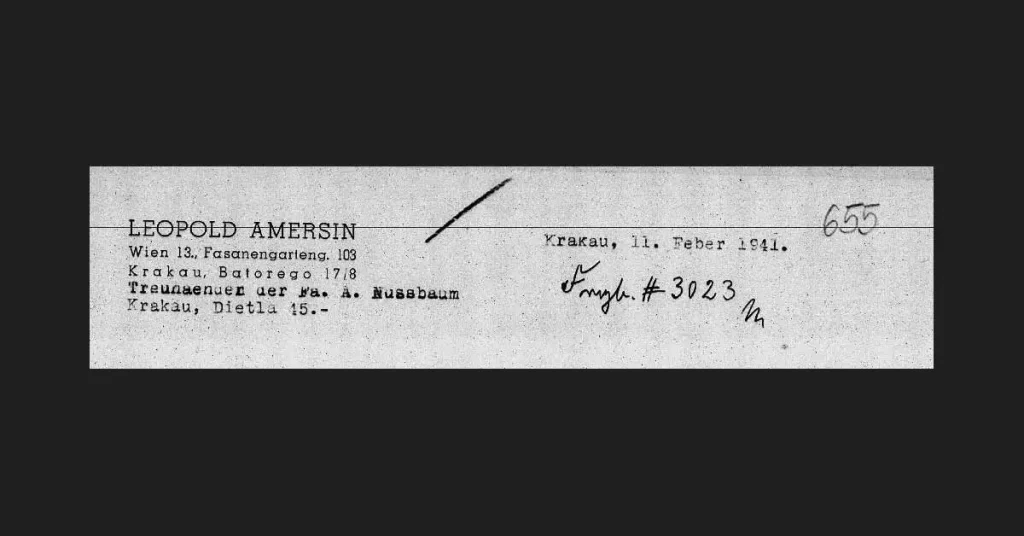
After publishing this article, I located additional documents in the USHMM collections relating to the firm A. Nussbaum. These include a letter dated 11 February 1941 in which the Treuhänder, Leopold Amersin, intervenes with the Department of Jewish Resettlement on behalf of another employee.

This document confirms his full name and clarifies his administrative role within the firm. The new material does not alter the narrative presented above but adds further detail to the bureaucratic environment in which Mala Englard lived and worked.
3. February 1941: the crisis point
And then the ground shifts.
On 22 February 1941, Mala is sent a formal notice: her request for continued residence in Kraków has been denied. She is ordered to report on 27 February to the Lubicz resettlement camp (located on 1 Mogilska Street), with her documents and three days’ provisions. She may bring 25 kilograms of luggage. Anything more will be confiscated. Her remaining property must be handed to the Treuhandstelle (German Trust Office).
It is clearly a bureaucratic document. No explanation is given. No appeal is mentioned. Just a date, a time, and the threat of punishment for non‑compliance.
For many, this would have been the end of the story.
But Mala’s case takes a sudden turn.
4. March 1941: the reversal
Barely a week later, on 3 March 1941, she receives another notice, this time granting her permission to remain in Kraków. She is instructed to collect her Kennkarte (a police-issued identification card) and the compulsory Jewish armband. She must bring photographs and pay a fee.
The deportation order has been overturned.
We do not know why. Perhaps Treuhänder Amersin intervened again. Perhaps her skills were needed. Perhaps the authorities simply changed their mind. The documents do not say. But the fact remains: she survived this moment, when many did not.
5. A single firm, before and after Aryanisation
One detail that becomes clearer the more the documents accumulate is that there was only one firm in Mala’s story:
A. Nussbaum, Dietla 45, Kraków
- Jewish‑owned before Aryanisation
- Run by Treuhänder L. Amersin by late 1940
- Employing Mala since 1929
From a Kraków Jewish Business to a Treuhänder
A Confiscated Business


Advertisement: Cofim newspaper. Dwutygodnik poświęcony sprawom żydowskim i syjonistycznym. R. 2, 1939, nr 2. 20 January 1939. (A biweekly magazine devoted to Jewish and Zionist affairs). Jagiellonian digital library. P2 in the PDF navigation. Stable link. Amtliches Fernsprechbuch für das Generalgouvernement. (Entry in the German telephone directory for the General Government). 1942. P29 in the PDF navigation. Radom Digital Library. Stable link.
This continuity matters. Mala wasn’t moving between businesses. She was a long‑standing employee of a single firm that changed hands under occupation. Her indispensability now makes more sense. So does the Treuhänder’s intervention on behalf of her family.
6. The question of identity
This brings us back to the first puzzle:
Is the Englardówna of the Berlińska Protokoll the same person as Mala Englard?
The short answer is: we cannot know.
The longer answer is more interesting.
The name on Salomea Berlińska’s Protokoll is not a signature. It is a clerk’s annotation, written quickly, probably by someone processing the file. There is no handwriting from Englardówna herself to compare with Mala’s signatures. So the link cannot be made through handwriting.
But the contextual clues are harder to ignore:
- the surname
- the city
- the timing
- the administrative setting
- the proximity to Jewish communal offices
- the fact that Mala was already working in Kraków in 1940
It is very possible that Englardówna was a different woman, perhaps a cousin, perhaps unrelated. It is equally possible that she was Mala herself, appearing in a different role before the machinery of occupation closed in on her.
The documents allow for a hypothesis, but not a conclusion.
7. What these fragments reveal
When I began this research, I thought I was following a marginal note. Instead, I found a woman navigating the changing rules of survival in occupied Kraków:
- exempted from expulsion
- registered and documented
- employed since before the war
- responsible for her family
- threatened with deportation
- saved by an appeal
- and still present in the city in early 1941
Her story is not complete. It may never be. But the fragments we have, petitions, questionnaires, employer letters, and exemption cards, show how much of wartime life survives only in paperwork.
These are the traces that remain.
A note on a memorial list and Mala Englard’s shool education
One detail sits slightly outside the main story, but it deserves mention.
A memorial journal published in New York in 1965 includes the name Amalia Englard among the Jews of Kraków who perished during the war. The first name is suggestive: Amalia was often shortened to Mala or Malka in Polish‑Jewish families.
You can view the image by tapping the placeholder caption text. (External link).

I cannot say whether the woman in the memorial is the same person whose documents I have been tracing. But the coincidence is striking enough to note. Out of respect for copyright and the families involved, I have not reproduced the memorial image here, but it can be viewed at the placeholder link above.
Mala Englard’s school education in Kielce
In 1926, there was a campaign where 5.5 million Polish citizens, nearly one-sixth of the country’s population at the time, signed a declaration of friendship to celebrate the 150th anniversary of U.S. independence.
Mala Englard’s signature is present within the list of signatures on the USA 1776-1926 Szkolnictwo Polskie w hołdzie narodowi amerykańskiemu na pamiątke 150-lecia niepodległości stanów zjednoczonych. (USA 1776-1926 Polish school education in Homage to the American Nation in commemoration of the 150th anniversary of independence of the United States).
This signature comes from her school records in Kielce, where she studied before moving to Kraków.

singature at the Stefania Wolmanowa’s
school for Jewish girls in Kielce.
https://archive.org/details/nybc304239/page/n81/mode/2up
Whether this Amalia was Mala herself or a relative, her name suggests that behind every document in this story is a life that continued beyond the page, or ended because of it.
PART II – Timeline: The Englard / Nussbaum Trail (1941–1942)
Exemption granted. Kenkarte No. 2055
Mala Englard receives an exemption from the expulsion of Jews from Kraków. Her address is recorded as Meiselsa 7.
Registration Questionnaire
She submits the required Jewish registration form. Her occupation, family, and residence are documented.
Employer Questionnaire (A. Nussbaum)
Her employer confirms she has worked there since 1929 as a bookkeeper. The firm is now under Treuhänder L. Amersin.
The Nussbaum Letter
Amersin requests that Mala be exempted from deportation because she is indispensable to the firm.
Rejection by the Chamber
A handwritten note orders the request to be rejected.
Deportation Order
Mala is instructed to report to the resettlement camp with her documents and provisions.
Appeal Granted
Her deportation order is overturned. She is told to collect her Kennkarte and Jewish armband.
Telephone Directory
The Nussbaum firm still appears in the official directory, though by now it is only a shell under German control.
Examining these records, I’m struck by how much of the war now only exists in snippets of archived information. No single piece offers a full picture, yet each points toward a person swept up in the occupation. We might never prove if the Englardówna of the 1940 Protokoll and the Mala Englard of 1941 were the same woman. Both were caught in the occupiers’ hold, trying to stay useful just to stay alive. It’s a reminder that history isn’t just made of big events; it’s built from these quiet traces on paper.
Documents Consulted
at the United States Holocaust Memorial Museum
Salomea Berlińska’s Protokoll. Dated 21 August 1940. Stable link.
Mala ordered to appear on 8 March 1941 to receive her Kennkarte. Dated 3 March 1941. Stable link.
Mala ordered to appear on 8 March 1941 to receive her Kennkarte. Dated 3 March 1941. Duplicated in the USHMM archives. Stable link.
Ausweis No. 2055 issued. Dated 15 August 1940. Stable link.
Questionnaire. Filled in by Mala Englard. With an A. Nussbaum stamp. Dated 27 February 1941. Stable link.
Questionnaire filled in by Mala Englard. With an A. Nussbaum stamp. Dated 9 November 1940. Stable link.
Rejection notice (for Mala’s continued residence) from the Krakow chamber of Commerce. Dated 14 February 1941. Stable link.
Mala issued with a Krakow expulsion order. Dated 22 February 1941. Stable link.
Letter from Mala asking for permission to remain resident in Krakow. Undated. Stable link.
Letter from Treuhänder Amersin of A. Nussbaum to the General Government in Krakow. He is chasing up a previously made request to have Mala’s sister and father to be issued with identification papers so that they are not separated from Mala. Amersin notes that Mala is already a “claimed and confirmed employee”. Dated 2 December 1940. Stable link.
Letter from Treuhänder Leopold Amersin of A. Nussbaum intervening with the Department of Jewish Resettlement on behalf of another employee. Dated 11 February 1941. Stable link.
Glossary of German terms used during World War II
| Ausweis | A general term for an official identity document or pass used in Nazi Germany and occupied Europe during WWII. |
| Generalgouvernement | A zone of Nazi-occupied central Poland during World War II that was not formally annexed into the Greater German Reich, but was instead managed as a separate colonial-style territory. |
| Kennkarte | A mandatory identity card issued by the Nazi German occupation authorities to residents of occupied Poland (the General Government) from roughly 1941 to 1943. It was a DIN (German Institute for Standardisation) A6 linen-reinforced booklet that served as the primary tool for surveillance, population control, and racial classification. |
| Protokoll | In the context of this post, this is a Formal Statement. |
| Treuhänder | A German trustee in charge of a firm after its Jewish owner had been removed. |
| Treuhandstelle | A Nazi state institution established in 1939 to systematically seize and “liquidate” Jewish and Polish property in occupied Poland. |
If you have information about Mala Englard or other persons mentioned in this post, or you would like to comment on this post, I would love to hear from you. You may also contact me privately via my contact page. My name is Andrzej.
Related posts on this website
Salomea Berlińska | From a Cieszyn Schoolroom to the Kraków Ghetto?
The Girls of Handlówka in Cieszyn: Class III.B of 1936

Subscribe to future posts by email. No spam, just an email when a new post is published. View the posts.
Articles tagged with Poland. See all in Poland.
Leopold Amersin: A Treuhänder in Occupied Kraków
Wanda Delong | Resistance Fighter From Cieszyn

Salomea Berlińska | From a Cieszyn Schoolroom to the Kraków Ghetto?

Jestem pełen uznania dla Autora. Solidna praca badawcza!
Bardzo dziękuję za miłe słowa! Cieszę się, że doceniasz czas włożony w przygotowanie tego materiału.